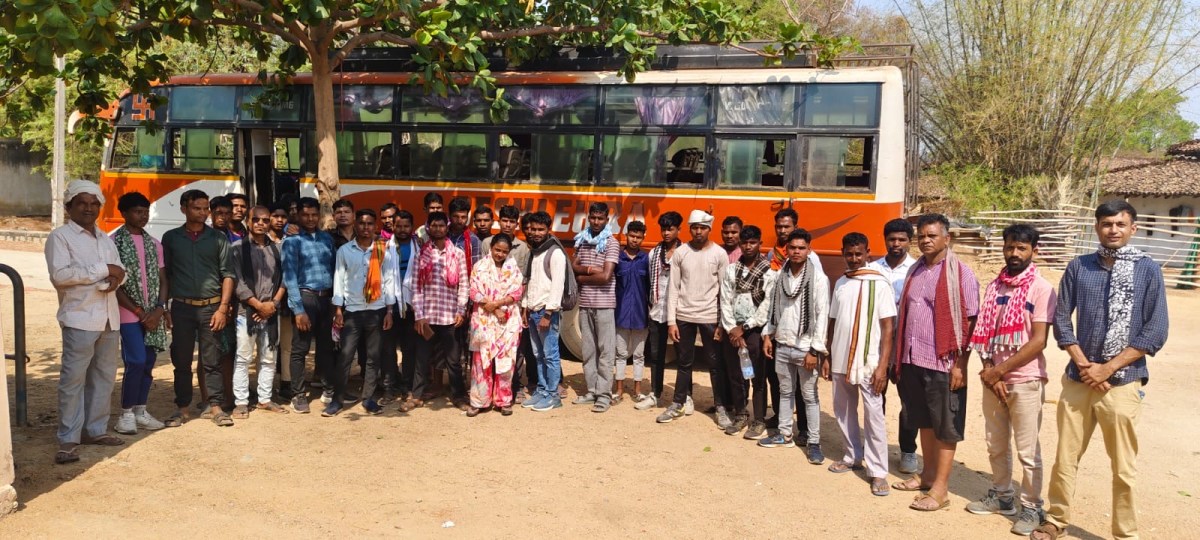
I recently facilitated an exposure visit with 40 youth leaders from 20 Gram Sabhas in Narayanpur as part of my Swar Fellowship journey to Pori village and Rofra Gram Sabha, Khamdogri. We travelled together to understand what community led development actually looks like on the ground when Gram Sabhas take charge of their forests, livelihoods, and institutions. They started the legal process for securing Community Forest Resource Rights (CFRR) in 2016 and finaly recieved the title on August 9, 2020. Since then they have been acting collectively to plan and develop their village with their own efforts as well as through convergence with local authorities.
The idea was simple but powerful. Instead of talking about change in abstract terms, we wanted young leaders to see working models of community forest rights management, women-led enterprises, local governance, and sustainable livelihoods. What unfolded over those two days was much deeper than just a learning visit. It was a shift in how many of us began to imagine development itself.
Our first stop was Pori Gram Sabha. Here, women’s self help groups have built a strong model around non-timber forest produce. They procure tamarind at slightly higher than market rates, process it by removing the shell and seeds, and then sell it at significantly higher prices. This simple act of value addition transforms incomes. Alongside tamarind, they are also working with harra, bahera, and mahua.
What stayed with me was not just the economics of it, but the social shift. Women spoke about how they had become financially independent, more confident, and more connected to each other. They also shared that local traders often try to disrupt their work. But instead of backing down, they treat this resistance as part of the process. Their collective strength has become their biggest asset.
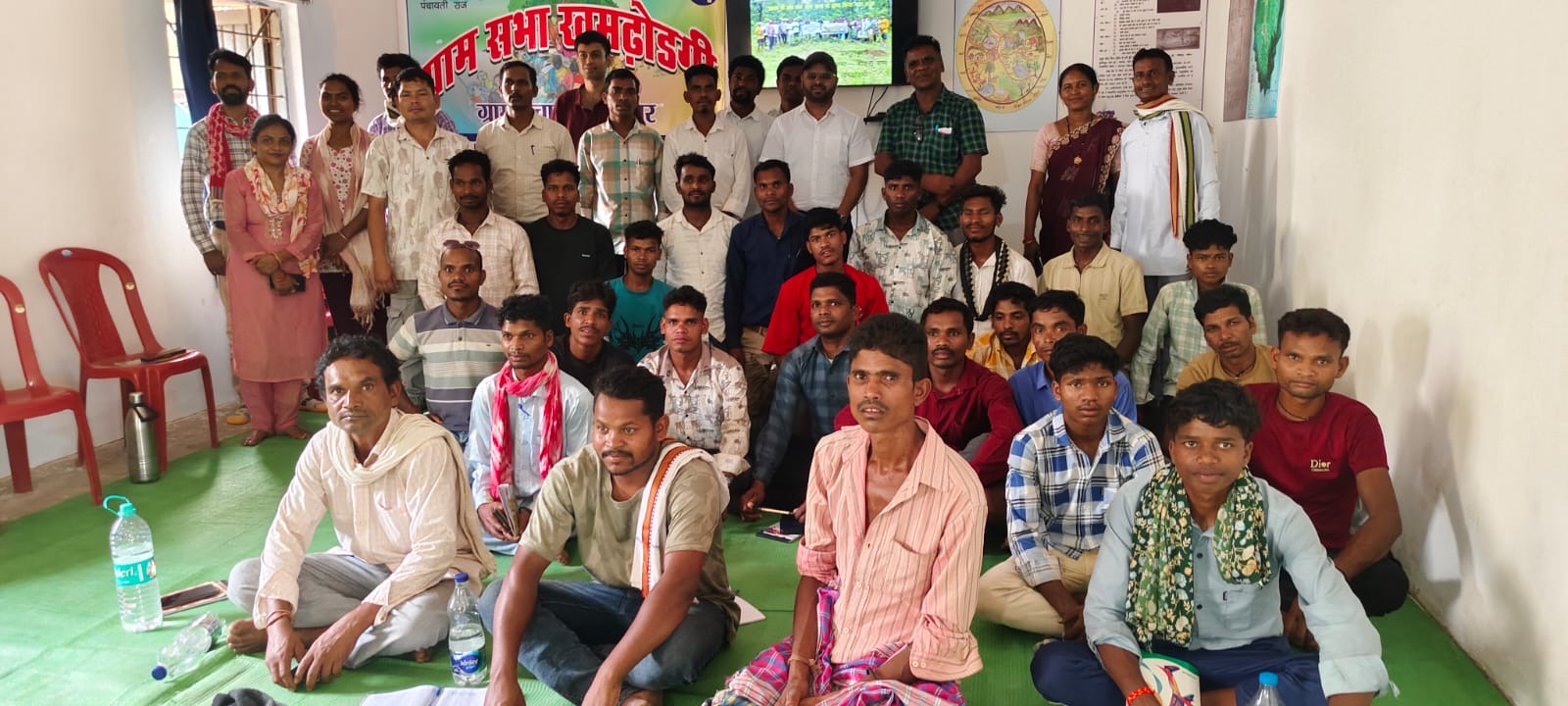
We then moved to Rofra Gram Sabha in Khamdogri village , where community forest rights are not just a legal entitlement but a living governance system. Khamdodgi, a small village with around 85 families, received CFR rights over nearly 930 hectares in 2020. Since then, they have developed a structured way of managing their forest.
They have divided the forest into four zones based on local knowledge. One part is used for grazing, while the others are protected and regenerated. This ensures that use and conservation go together instead of being in conflict. They have built a dam on a small rivulet that acts as a source of water and also invites tourists which then brings in revenue.
What I found particularly striking was the institutional clarity. The Gram Sabha has made it mandatory for any external organization to seek permission at least 15 days in advance before starting work in the village. This small rule reflects something much larger. It asserts that the village is not a passive beneficiary but an active decision-maker.
Livelihood efforts here are diverse and locally rooted. The community has generated income through fisheries, supported by clear rules to prevent overuse. There has been government support for boats, and tourism has also emerged as a revenue source. Women have even built a shopping complex through their own pooled resources. Young people are running a tent house service, reducing dependence on outside providers.
There is also a strong emphasis on environmental responsibility. A group called the Paryavaran Mitra Sena has been formed, where each household contributes one youth member. They take up plantation, waste management, and conservation work. Development schemes like MGNREGA and watershed programs are being used in a coordinated way rather than in isolation.
During our discussions with the Gram Sabha, one idea kept coming back. Development cannot be reduced to food, clothing, and shelter. It has to include the future of natural resources and the well-being of coming generations. Forests, water, and land are not infinite. If they are not managed carefully, the consequences will be irreversible.
There was also a reflection on knowledge. Many participants spoke about how traditional practices like bone setting and herbal medicine are disappearing over time. This raised an important question about what kind of knowledge we preserve and what we lose in the name of progress.
Another insight that stayed with me was that change does not always require innovation. Sometimes it is about using what already exists more thoughtfully and consistently. One example shared was of a village where every household contributes one member daily for cleaning work. The system is simple, but the discipline it creates is transformative.
On the second day, we visited water conservation structures like ponds, fishery units, and a percolation tank. These are not just technical interventions. They are directly linked to livelihoods and resilience. We also saw a custard apple processing unit that stands as an example of how local produce can be turned into enterprise.
We also came across cultural markers like Haatha Pathar and Handa Pathar, which carry the memory of the community. These are reminders that development is not just economic. It is also about identity and continuity.
One of the most honest conversations we had was about conflict. Community members openly shared that resistance and setbacks are inevitable. Change is slow. They see themselves as having achieved maybe 30 percent of what they aim for. The rest is still work in progress.
They have also created local rules around resources like mahua to prevent misuse and over-commercialization. There is a conscious effort to maintain social unity, reduce substance abuse, and stay away from divisive politics.
As we returned, I could see that something had shifted among the youth leaders. This was not just exposure. It was a reorientation. They were no longer seeing development as something delivered from outside, but something built from within.
For me, this experience reinforced a core belief. Strong Gram Sabhas, collective decision making, transparency, and respect for local knowledge can create sustainable and inclusive development even with limited resources. CFRR is a very important legal entitlement that can protect and empower villages to take ownership of their resources and also gradually generate oppurtunities for a dignified living
The real work now lies in what happens after this visit. Whether these learnings travel back into the villages. Whether they take root. And whether these young leaders begin to see themselves not just as participants, but as custodians of change.
 iVolunteer Blog - everything about volunteering