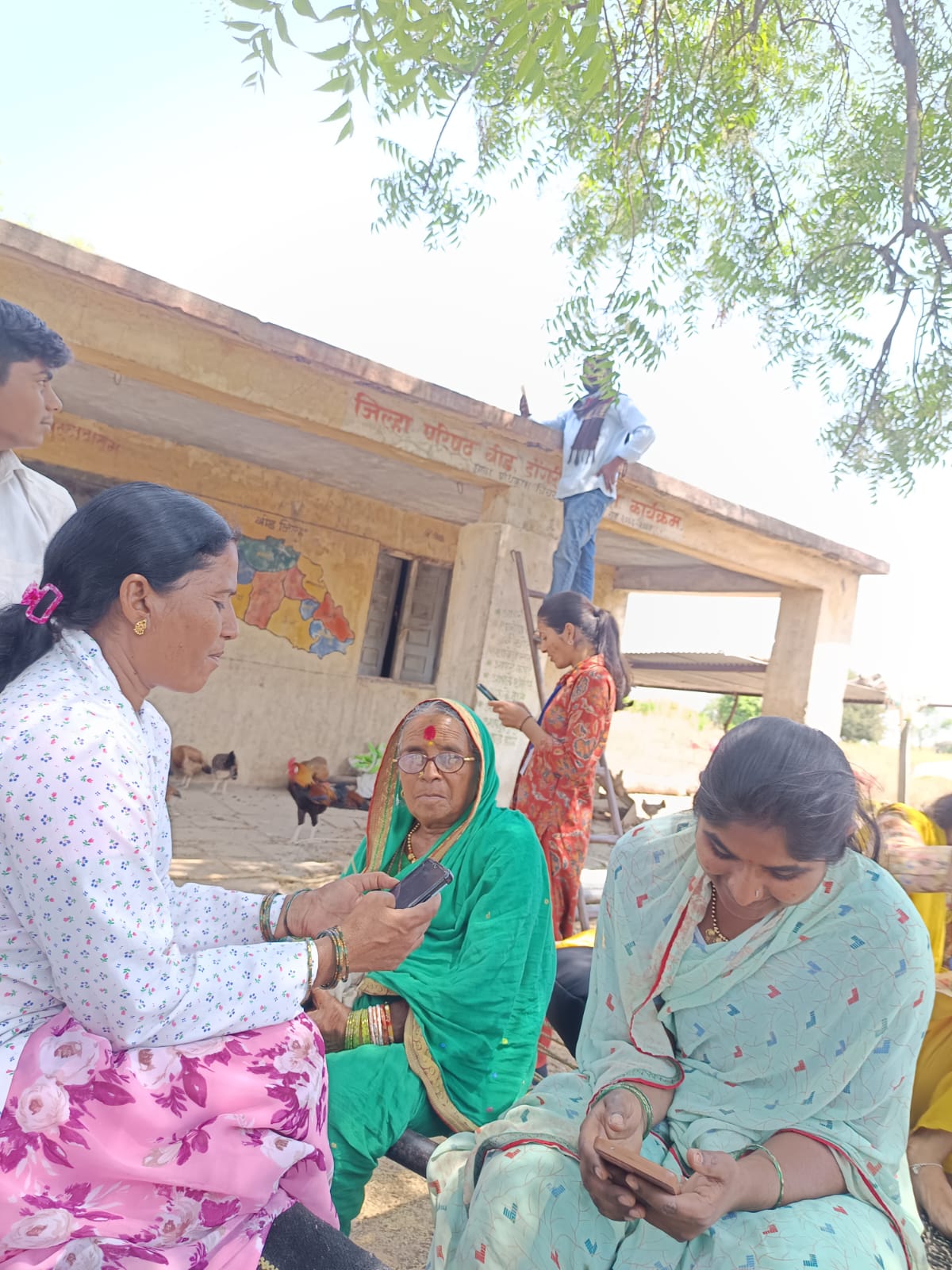
In one of the GramUrja advocacy programs, governance is more decentralised than you read in books. Now the power doesn’t lies only in Sarpanch, but in all the residents of the village. The goal of the program is to strengthen local governance by bringing accessibility and awareness of various government schemes like insurance, health, subsidies, skills and housing to the migrant rural community.
To ensure sustainability of the program, the local leaders are trained as Gram Mitras or Gram Sakhis who would support the community to enroll them in various government schemes. They will be trained in technical work like filling of forms, conducting survey, organise community meetings, and documentation.
A Gram Sakhi (to be called Tai here) in Sakud village is a BA graduate and a mother of two kids, barely able to sustain themselves. She had lived in Nashik for nearly 10 years post her marriage. In her early later 20s she was diagnosed with a mental health disorder that affects her through hallucinations and delusions. She faces difficulty in processing thoughts and emotions, and many a times her speech also becomes disorganised and people withdrew socially. After she was diagnosed with the mental health disorder, she was abandoned by her husband. With two kids, she came back to her village to live with her parents. Left with no hope for life, she suffered the disorder, the broken relationship, and the responsibilities. All she was being is consistent with her efforts of making her livelihood needs meet, but no one believed her. Burdened by her own medical expenses, and the needs of her children and almost no response from the employers left her broken.
Seeing her need, and her educational qualifications and some technical knowledge on how to operate applications, she was selected by GramUrja Foundation as one of the “Gram Sakhis” whose role was to be an intermediate between the organisation and the community. She was assigned to conduct survey of the village understanding the demography, migration and penetration of government schemes. She seemed excited and ready to put in whatever it takes. She was relieved, and said
“अखेर मला काम मिळालं”.
In a day, the training of Gram Sakhis began. Almost all of women participated with great enthusiasm. But Tai was low confident, filled with self doubts, didn’t participate much during training sessions. Many a times, she didn’t understand the concepts the first time, and it required much effort to teach her again and again. Once the training was completed, she learnt something but not everything. Hesitatingly, she confirmed that she will do it.
Once the ground work began, everyone except Tai were doing their part, others were surveying more than 30, she could only do around 8-10. She was facing technical problems while operating on Google forms as her phone was not technically sound. More than that, she was consumed by her low self confidence, doubting her every action. The lukewarm response from the community by not providing her with the information asked, added to her self doubts. People were questioning about why she is doing, making comments about her mental health conditions, people arguing more than they were responding. The more grievous was people remarking over her backward caste, people were giving wrong information. All these conditions broke her. But she was very much convinced that she wanted to support her family, no matter what.
Many a times, she calls the field coordinators to talk about the challenges she was facing, the coordinators listened and explained her things. But it was difficult for her to understand or relate to field coordinators. She required special attention and a face to face interaction, so that she understands the things completely.
One of our field coordinators took the initiative to work with her and restore her belief in herself. She calmed her down, made her understand to let go of what is not working or the one who’s not responding. She made her realise confidence in her self and their belief in her capabilities. She tried almost best to resolve all the technical issues by getting her phone repaired. She explained her how to talk to families, what to explain about the organisation. She also accompanied her while conducting surveys.
In a matter of 5 days, she re gained the momentum. Her honesty towards work was incomparable. When other Gram Sakhis or Gram Mitras began with great enthusiasm for work, but could not retain the excitement, when they started taking leaves or making excuses for work, Tai stood committed to her work, she put more efforts, she honestly spoke about the ground level challenges she was facing and shown her deep interest to be a part of the initiative. In a span of a month, she has surveyed more than 500 individuals. Special efforts are taken by the Gram Connect team who didn’t compared her with other Gram Sakhis or Gram Mitras rather restored her confidence in her abilities.
You see, we live in highly competitive world that requires our knowledge, skills, confidence and motivation, all working together to bring better outcomes in our endeavours. Many a times, we are also pulled down by internal and external factors, beyond our control. How do we cope up with that? Tai’s story tells about the consistent effort for a cause, being honest about your endeavours and speaking about your challenges to the concerned people but committed to work for improvement. For her escape didn’t existed and even not for us, all we can do is to believe in ourselves and strive towards being better each day.
(note: the photo added in this blog is not of the person mentioned. Their name and identity is protected.)
 iVolunteer Blog - everything about volunteering