

Introduction
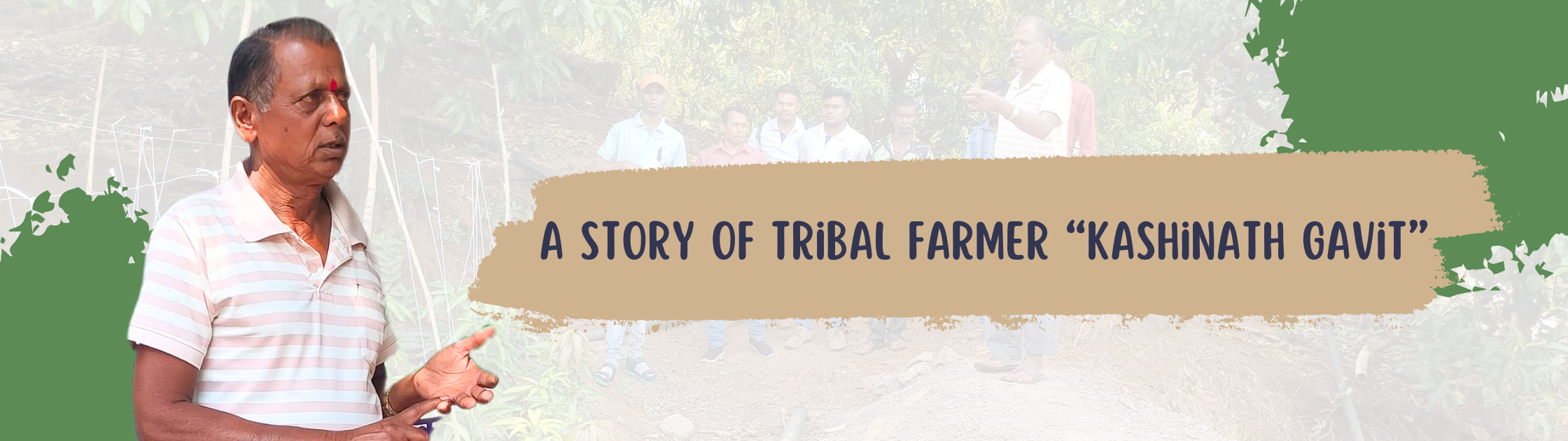
During a recent trip, I had the opportunity to explore Wanvashi, a village situated just 15 kilometers from the city of Jawhar in Palghar. Wanvashi is renowned for its history of sand mining and the resilience of its labourers who face significant challenges in their pursuit of a livelihood. During my visit, I had the privilege of meeting an individual who has since transformed into an entrepreneur, educator, and an exemplar in the field of agriculture. He has also dealt with the traps of vicious cycles of poverty and bonded sand mining labour. Kashinath Gavit, a tribal farmer, who lives with his seven family members in the village of Wanvashi. He owns approximately 6 acres of land, part of which is along the plains. Almost half of the land is on a slope and is quite degraded. The family depends on agriculture as their primary source of livelihood, and the lack of agricultural resources forces them to work as sand mining laborers.
Sand Miners and the Past (History):
Agriculture was mainly at the subsistence level, with major crops cultivated being rice, finger millets, and black gram. Cultivation was restricted to the monsoon season only. large numbers of farmers were forced to abandon their farms and migrate to cities in search of work, ultimately as a result, a significant percentage of small farms were left fallow and not put to productive use. After the harvest of the Kharif crop, Kashinath had no other alternative source of livelihood within the village and hence had to work as sand miner.
Sand Mining to Land Cultivation (Intervention):
The tribal farmers, including Kashinath, had barren fields, leading to soil erosion and loss of fertility. They had to resort to seasonal migration or work as sand mining labor, impacting their family’s nutrition, health, and children’s education. Migration only provided subsistence, and many families in the area faced similar challenges. In 2001, The BAIF Development Research Foundation (BAIF)[1] came into this village and understood that there is an urgent need for alternative cropping systems to ensure sustainable livelihoods and natural resource sustainability. Horticulture crops such as fruits, vegetables, and flowers have great potential for this. They introduced and scaled up the Wadi[2] program, promoting fruit trees and horticulture and forestry in farming systems. Kashinath was the first participant in this Wadi Program.
Bare Land to Prosperous Land:
Kashinath initially lacked confidence in planting due to the degraded land. With support from BAIF, a farming system improvement plan was prepared. Kashinath committed to providing labor and training and received support in planting materials, fertilizers, and training. Various pre-plantation activities were carried out, and Kashinath planted 20 mango and 30 cashew plants, along with 100 forestry saplings along the border. He also initiated various organic practices including recycling of farm residues, green manuring, application of Jeevamrut[3], etc. These practices along with soil conservation helped in improving the soils. The enhanced farm production has resulted in improved consumption of vegetables and fruits at the household level. This has helped in improved nutrition at the family level. The surplus fruits and vegetables have resulted in a significant increase in family income. They are no longer dependent on sand mining labor work.
Degraded Land to Fruitful Land:
This initiative has resulted in a significant transformation in the farming system, leading to increased farm returns and improved natural resources. After 4 years, Kashinath experienced the positive outcomes of the Wadi Programme as he sold mangoes and cashew nuts to vendors, thereby earning money and achieving economic stability in the Rabi season. Later, he decided to give this initiative a turn towards a farm nursery. He started making grafted saplings of Mango and Mogra as guided by BAIF, so that he could sell those to organizations like BAIF and others, making the organization a supplier of grafted saplings as a surplus income.
In the years that followed, he dedicated himself to improving his life by developing his orchard on the remaining land. Initially, the community in his village ridiculed his orchard initiative as it was a new concept for all of them. However, he inspired many to adopt the orchard concept and catalyzed change. Currently, he sells 60,000 saplings a year to organizations such as BAIF, CSR companies, NGOs, and NPOs, earning between eight to ten lakhs per annum. It took him 22 years to reach this milestone and founded his enterprise called “Jagruti Farms Nursery”. Over time, he invested the money in a solid house and his children’s education. The Agri-horticulture initiatives have not only created positive impacts at the individual family level but have also created employment opportunities at the community level, as Kashinath provides employment opportunities to villagers for grafting and farm-based activities.
Farmer to Model Farmer:
After achieving success, BAIF started organizing exposure visits for farmers to Kashinath’s farm. Slowly, he became the facilitator and then a trainer to demonstrate the Wadi Model and its scope, challenges, and benefits through his story. Many farmers were inspired by him and started developing their own Wadis. Later, Kashinath received support from government and non-government organizations, including new plantation support for introducing the Banana Cultivation Model, water resource support such as farm ponds, and water pump support. He also invested in expanding his Wadi farmland.
Over time, he became the trainer for trainers, also known as the Master Trainer of the Wadi Model, and was invited to various parts of the states. He was also honored with many awards and titles by the District and State Agriculture Departments of Maharashtra and was appreciated by farm-based CSR companies. Earlier the village was identified as the ‘Village of Sand Miner’ now it is called the ‘Village of Ideal Horticulture Model’. This is an inspiration for the other farmers to participate and implement such sustainable initiatives.
Hope of Rise for the Farmers:
With the wadi intervention areas emerging as hubs of vegetable and fruit production, there is a further opportunity to link these farmers to local and regional markets through value chain interventions and food processing-based enterprises to achieve further economic gains for the farmers.
[1] The BAIF Development Research Foundation is an NGO based in Urali Kanchan near Pune in Maharashtra, India, that pioneers agricultural development. It was founded in 1967 by Manibhai Desai as the Bharatiya Agro Industries Foundation.
[2] The wadi model is an Agri-Horti-based sustainable livelihood model that makes farming profitable even on small farms.
[3] Jeevamrut is liquid organic manure made from cow dung and urine, jaggery, pulse flour, soil, and water. It provides crops with nutrients like carbon, nitrogen, phosphorus, and potassium.

 iVolunteer Blog - everything about volunteering
One reply on “From Sand Mining to Land Cultivation”
very well written.
LikeLike