
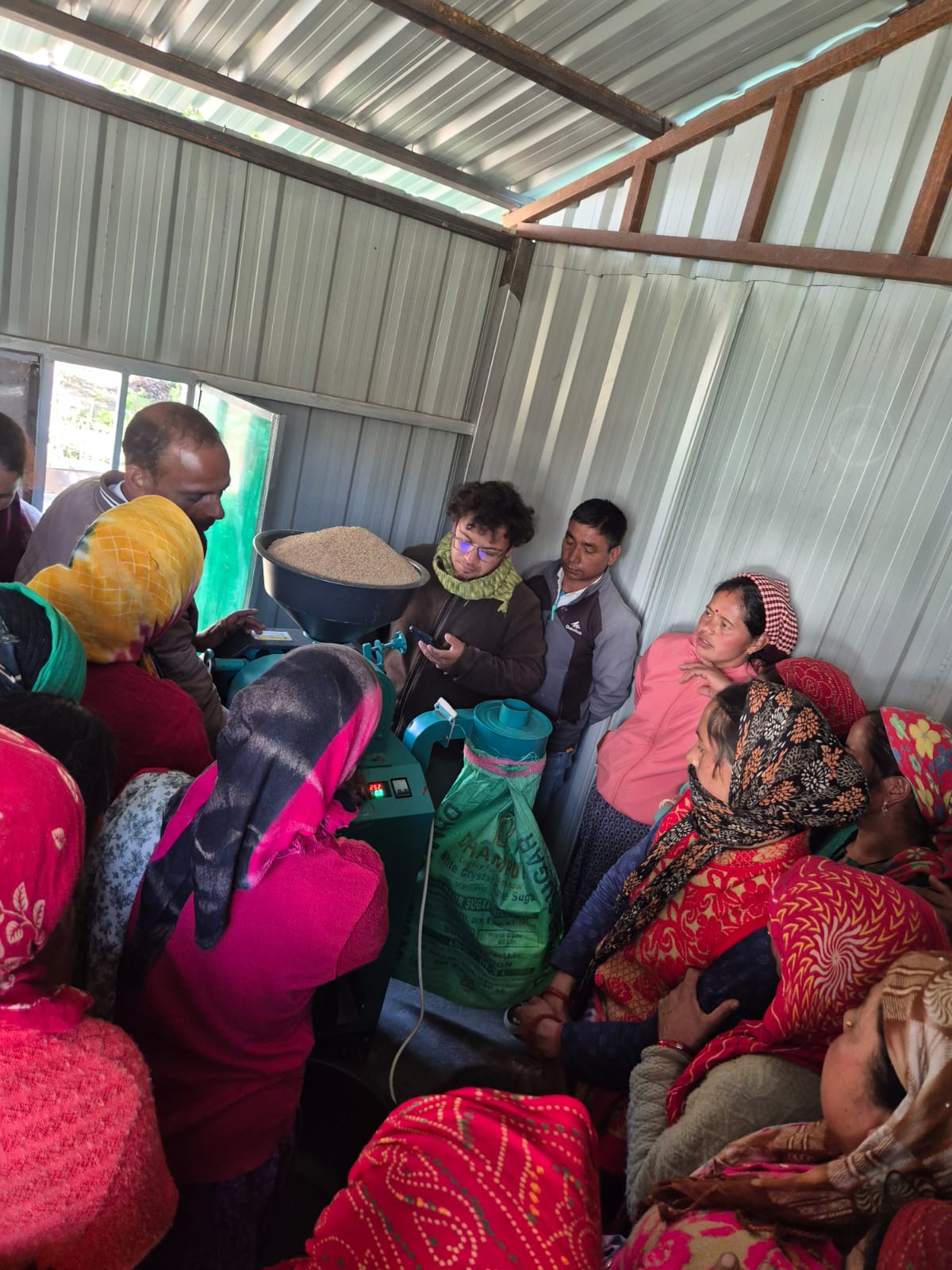
Working in the hills of Uttarakhand has consistently reinforced one lesson: no intervention here is complete without negotiating with geography. The installation of millet processing machines in Parwari village was one such experience. A process that highlighted not only the labor-intensiveness of traditional millet processing but also the physical effort required simply to introduce change. My fellowship project focuses on increasing millet productivity, promoting self-consumption, and establishing processing unit sheds within two villages- Sarkot and Parwari, and their toks (hamlets). In this blog, I want to narrow down to one defining experience- placing millet processing machines in Parwari village. While the objectives may sound straightforward, the realities of execution in a mountainous region are anything but that; factors such as difficult terrain, variable weather conditions, and limited access to resources present unique challenges that must be navigated with care and creativity.
The Context: Labour Hidden in Everyday Life
Before introducing machinery, it was essential to understand what we were attempting to change. The average Pahadi woman’s day is structured around physical toil. Farming here is largely subsistence-based. Men often migrate or engage in trade, while women handle agricultural operations- sowing, harvesting, threshing, de-husking, grading, and processing. Through our field study, we documented the time taken to process 50 kilograms of millets through the stages of threshing, de-husking, grading and pulverizing. Pulverizing is done only for madua (to make rotis). Jhangora is not pulverized as it is usually de-husked and then consumed as rice or used for making kheer and other dishes. Time taken to process 50 kilograms of millets:
- Madua (finger millet): 15 hours
- Jhangora (barnyard millet): 29 hours
Let that sink in.
Twenty-nine hours to process 50 kilograms of jhangora. By ‘processing’ I mean, readying it to the last stage available for/ prior to cooking. Traditionally, threshing is done through the cow-hooves rotation method, which is when cattle are made to walk over harvested millets in circular motion. De-husking is done by beating the grain using the okkal, a traditional wooden hand tool that requires repetitive manual effort over several hours. By understanding these traditional techniques, we gain a deeper appreciation for the hard work that goes into our food production. Pulverizing madua into flour alone takes nearly 10 hours.
These hours are not abstract statistics; they are cumulative physical strains on the wrists, backs, knees, and spines.These tasks are routine aspects of agricultural life, largely undertaken by women. The physical toll of such labor is continuous and fatiguing; however, the resilience of these women is quite evident as they carry on, balancing their agricultural responsibilities with other household duties. Thus it became necessary that we introduce supportive measures that help in reducing processing time and thereby directly reduce labour strain and free up substantial hours within their already demanding daily schedules.
Reaching Parwari: The Logistical Barrier
Transporting the machines to Parwari brought into focus a dimension of working in hilly terrain that is often overlooked. The village is accessible only up to a certain point by vehicle, which significantly complicates logistics and planning. Beyond that, the road becomes narrow, uneven, and in some stretches, non-motorable, making it challenging to move equipment and supplies. This necessitates careful coordination of transportation, often requiring the use of smaller vehicles or even manual labor to carry essential tools and machinery on foot, which is exactly what we did.
The machines — de-huskers, graders, and pulverizers — are bulky and heavy. The de-husker weighed 120 kg, the pulverizer 85 kg and the spiral grader around 35 kg. Once the vehicle reached its limit, the remaining distance had to be covered manually. There are no cranes or some other mechanised unloading system available at the last mile. There are only people.
To move the machines uphill to the processing shed site, we tied long wooden sticks securely to both sides of each unit, creating makeshift handles. The idea was simple: add sticks to specific points on the machine so that it could be lifted and carried. This allowed groups of four to six community members to lift and place the machines on their shoulders and transport them along the rugged path. Sticks were sourced locally. Ropes were tightened. Knots were double-checked. The metal edges were padded wherever possible using the cardboard the machine came packed in. Then came the lifting.
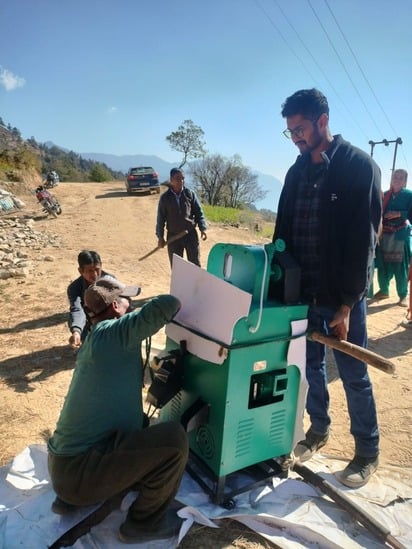
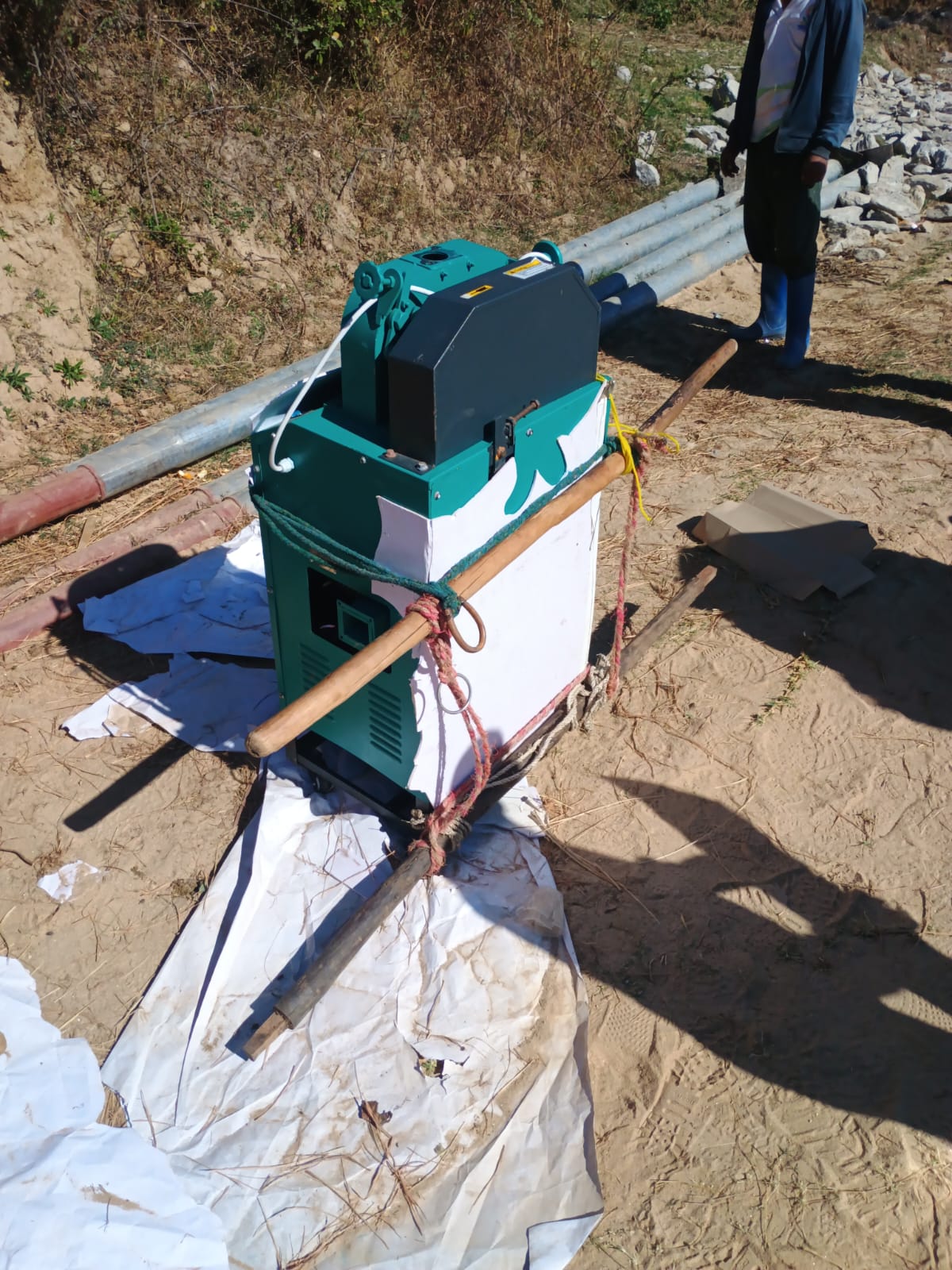
The terrain consisted of steep inclines, loose stones, and narrow foot trails cutting through terraced fields. Movement had to be slow and coordinated, as every misstep could lead to a tumble down the rocky slope. The sun beat down on their backs, adding to the exertion, yet they carried on, driven by the necessity of reaching their destination. The machines were carried in segments, lifted, moved a short distance, rested, adjusted, and lifted again. At steeper points, those in front bore greater weight while others stabilized from behind. There was no alternative. If the machines were to reach the shed, they had to be carried.
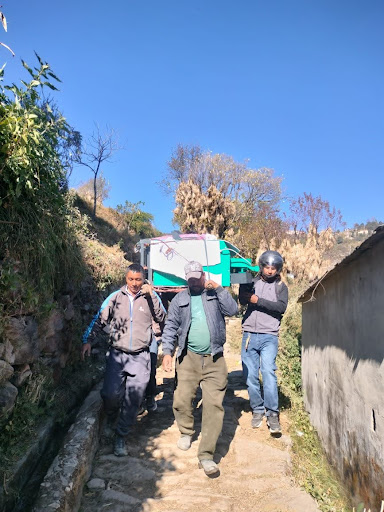
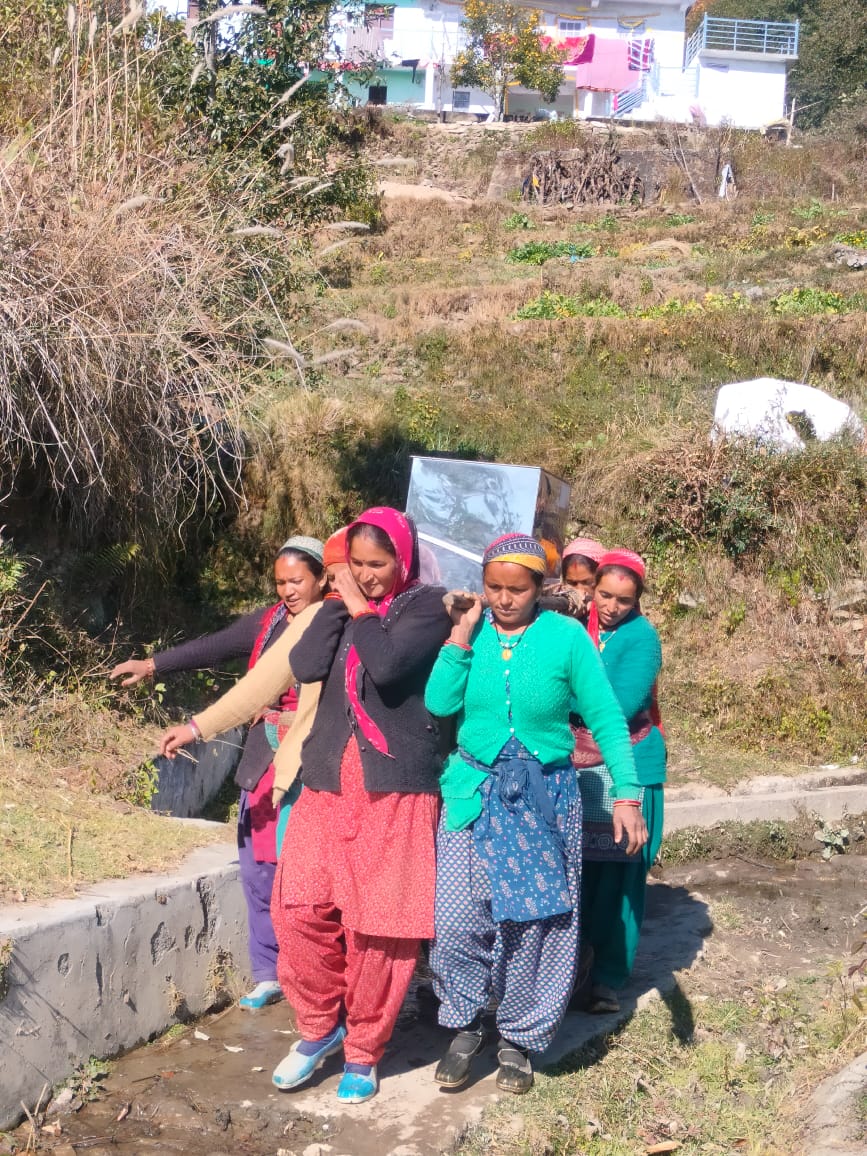
This experience encapsulated what community interventions in such terrains often entail: progress is physically demanding, and the ‘last mile’ can require the greatest effort. Each step forward demands not only physical stamina but also a deep commitment to collaboration and resilience among team members and community stakeholders. The machines finally reached the processing shed and took to its new home. It was in that final stretch where the true spirit of community engagement was tested, revealing the strength and determination required to overcome barriers and achieve sustainable change.
Measurable Reduction in Processing Time
Once the machines were installed and the operational training completed, the time reduction was substantial.
For Madua (50 kg):
- De-husking reduced from 2.5 hours to 30–40 minutes
- Grading reduced from 1 hour to 30 minutes
- Pulverizing reduced from 10 hours to 5 hours
Total time saved: approximately 6.5 hours
For Jhangora (50 kg):
- De-husking reduced from 25 hours to 2 hours
- Grading reduced from 4 hours to 30–40 minutes.
As stated earlier, jhangora is usually not pulverized and is consumed as rice itself.
Total time saved: approximately 26 hours
Twenty-six hours saved. Think about that. More than an entire day reclaimed. Processing is not a side task. It is THE task. The eradication of intense physical labour is significant but what is more transformative is the time that opens up. Time to rest. Time to attend a mela. Time to sit without pounding grain under the sun. Time to explore value-addition activities.
Time being the only true currency, is a statement I hold close to my heart.
Impact beyond ‘Time saved’
The most immediate impact is the reduction of intense manual labour. Tasks that previously required prolonged repetitive effort can now be completed within a fraction of the time. The machine does not erase labour entirely. Farming remains labour-intensive. But it redistributes strain. The people are now less likely to suffer from injuries related to physical exertion. Shoulders that once lifted pounding tools for hours now operate levers. Wrists that rotated endlessly now guide grain flow. Backs that bent repeatedly now straighten sooner and are at ease.
And perhaps most importantly — knowledge stays.
These community women have been trained to operate the machines independently, empowering them with essential skills and confidence in their abilities. This training not only enhances their personal growth but also fosters a sense of pride and ownership in their work. As a result, the knowledge remains within the village, ensuring long-term sustainability and enabling the community to thrive economically. Furthermore, this initiative creates a support network among the women, encouraging collaboration and innovation in their practices.
The machines also improve output quality through uniform grading and cleaner processing. This strengthens the potential for value addition, packaging, and hence improved market linkage in the future becomes increasingly feasible. When millets are easier to process, households are more inclined to consume them rather than sell raw produce at lower margins. Nutritional security strengthens alongside economic potential.
What appears straightforward in proposal documents often requires improvisation on the ground, where reality does not always align with expectations. Carrying machinery manually over rugged paths is not an exception — it is sometimes the only viable option. Yet, despite the logistical barriers, the results justify the effort. When time-intensive manual processes are reduced from nearly a full day to a few hours, the impact is tangible and immediate.
Conclusion
Working in Uttarakhand constantly reminds me that terrain is not a backdrop. It is an active participant. Humility becomes necessary because the mountains constantly remind you that you are not in control. On paper, installing machines sounds straightforward. Procure machinery. Transport it. Install it. Train community members. The hills laugh at such linear thinking. In Kerala, where I come from, transporting equipment to a village would involve a truck, a paved road, perhaps a short unloading process. Here, the last mile can be the longest.
Plans drafted in offices often undergo correction once they meet broken roads, steep slopes, and limited accessibility. So when we speak of intervention, we are not merely installing equipment. We are negotiating with a deeply embedded system of labour. The machine is not merely a labour-saving device; it is a bridge between subsistence and possibility. We were paving the way for a brighter future, one where technology and traditional practices could coexist harmoniously.
There is a romanticised idea of development work — meetings under trees, participatory discussions, smiling beneficiaries. Installing millet processing machines in Parwari was not simply an act of infrastructure placement. It was a demonstration of how geography shapes both problems and solutions. The labour involved in carrying the machines up broken mountain paths displayed the labour we were attempting to reduce within households. But when the machine finally rests in its shed, and the first batch of millets runs through it — the weight feels lighter.
Today, the processing shed functions as a practical asset for the community. Processing time has decreased significantly. Physical strain has reduced. Opportunities for value addition and improved self-consumption have increased. Each step taken was a testament to their determination and resilience, as they navigated the rugged terrain. When I now see women processing millets in hours instead of days, attending local festivities, or simply sitting down a little earlier in the evening — I am reminded that sometimes the most meaningful development is not loud or dramatic.
It is quiet.
 iVolunteer Blog - everything about volunteering