
A year ago, if anyone asked me where I am going to work ? I would have said anything, but not crochet for sure. I entered this fellowship with the mindset that I would be placed in a small, remote village with limited access to electricity and poor road connectivity. What I found was different but not completely different from my expectations.
Anyway, coming back to the topic, the project I was assigned during my induction was on women’s entrepreneurship. After arriving at the location, Almora in Uttarakhand, at Udhyam, my assigned organization, I learned that it would happen with the help of CROCHET. I was completely new to this crochet thing, and gradually, I explored the ABCD of crochet.
Since the time of its training in August 2025, when I was watching the women of Hamari Bakhli making a complex knot with the crochet needle and yarn, a thought came to mind about when and how it would have started. Its history is really very fascinating for me to imagine how it all would have started, and the time someone would have made this knot for the first time. This curiosity was born when I was reading about it to understand its market dynamics, its supply and demand chain.
When I searched about its origin, it wasn’t surprising but a bit weird for me that crochet did not originate in India, then where, well, no one actually knows where and when it first began. Some say it was in East Asia, the Persian region, for some it was in Scandinavian countries. Then slowly, with trade and traders, it spreads to other regions of the world. In Asia, it first came in China with the Silk Route. In India it came with European Colonizers first around Goa region in the first half of the 17th Centaury.
Yes, the word crochet genesis has some certainty in it; It comes from the Old French word “croche”, meaning hook or curved instrument.
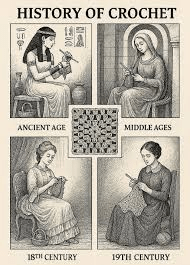
So, do we have crochet sample remains from the past? Yes, we do, and since it is a fabric material, the oldest crochet material we have is from the 16th and 17th centuries. At that time, intricate lace designs of crochet were made primarily for church and royal uses. There are also theories that the decomposed crochet designs were found in the Egyptian Mummies’ tombs.
Pic 1: A Visual reference of Crochet History
Crochet became widely popular in Europe in the 19th century, especially in England, France, and Ireland. It became a source of income during the Irish Famine (1845–1849). Irish women created fine lace crochet to earn income and support their families. In the Victorian era, Crochet became a fashionable hobby; even Queen Victoria knew this art form.
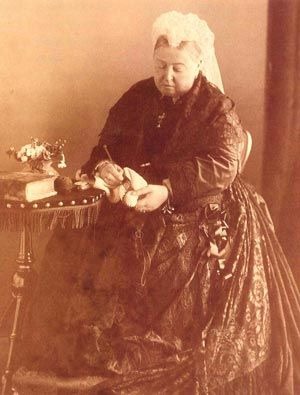
Pic 2: Queen Victoria doing Crochet.
In the 20th century, with 2 world wars, it became a necessity rather than creativity, women started making warm clothes with crochet for soldiers fighting on the lines. Then, after the settling of chaos in the world, it became popular among film artists, and a new wave of crochet revolution started taking place, with models walking on the ramp with crochet designs on their clothes.
In the early 1980s and 1990s, its trend declined, and was replaced with new designer clothing like jeans and frocks. As said, new fashion is nothing but a revival of the old one. So once again the crochet has become a new trend, the market is expanding, and history is repeating itself one more time.
Now the youth group is the biggest consumer of the Crochet products worldwide. They are also emerging as the artist of it; crochet is again becoming a hobby among Gen Z. But here is an interesting fact, this trend and consumption are majorly centered around the cities, both as a hobby and consumption.
Once again this art is becoming a product in market and source of livelihood for thousands, this time its nor war neither famine its more about demand from people who are now looking beyond machine made clothes and a change in fashion.
 iVolunteer Blog - everything about volunteering