
During my education and early career, I was introduced to the technical expertise and guiding principles behind project design and management. However, exposure to the development sector brought a set of unique challenges I had never faced before – whether it was regarding involving the community as a stakeholder or iterating at an unprecedented frequency to meet stakeholder demands in a system where engaging all components simultaneously was required.
During the fellowship, one aspect that caught my eye immensely was the opportunity to conduct personal exposure visits to observe the successful workings of organisations and receive training from them in various project aspects. During challenging times of the project, the program coordinator, Mr Kishor Gajghate, suggested that I take up an exposure visit to Palghar district in Maharashtra and observe the multitude of organisations working in the livelihood domain in the villages therein. I decided to grab the opportunity with both hands.
The primary purpose was to learn about the workings of established organisations like BAIF, Raah Foundation, and Action Against Hunger in the agricultural, allied agricultural, and non-agricultural livelihood sectors and glean ideas from them. With an inquisitive mind, I embarked on a two-day journey on February 20, 2025, to visit the aforementioned organisations in the Jawhar taluka of Palghar district.
Day 1 began with a visit to the Taluka-level agricultural and governmental offices. With an eye on leveraging animal husbandry, the Taluka Agricultural Officer suggested a visit to a farm family supported in poultry cultivation by the Aarohan Foundation in Dengachimet village, located 12 km away from Jawhar town. I was able to visit the poultry unit of Lakshmi Tai in Dengachimet village. Tai was supported by the Aarohan Foundation in the procurement of 130 chickens (the majority of which were aged between 30-45 days) of the Kaveri Breed. Additionally, Aarohan endorsed the construction of a chicken coop equipped with feed and water bowls, as well as warming bulbs, to provide a warm environment for the chickens to be reared.

Training was provided to farm families on chicken and coop maintenance, as well as health monitoring of the chickens. Vaccinations were supported by Aarohan, while feed was to be procured by the farm family themselves. This arrangement ensures that the stakeholder is provided with handheld support while their involvement is ensured through their personal participation in feed procurement. Having faced a similar issue with stakeholder involvement during the execution of the pilot project idea, I learnt of an effective method for involving farm stakeholders. The main challenge we faced was the lack of stakeholder involvement, which was crucial for the success of our project. This visit provided valuable insights on how to overcome this challenge.
The evening was capped with a visit to Action Against Hunger, another NGO supporting poultry framing in Mokhada. While their modus operandi was similar, they provided chickens which were 60 days old and provided feed and enclosure fencing instead of a coop. They mention that this method is more effective since a 60-day chicken is more likely to survive due to the provision of necessary vaccines and a better growth stage, hence reducing the stakeholder time commitment.
The second day involved a visit to ideal farmers who incorporated an Integrated Farm System tailored to the local weather. Witnessing the high prevalence of rainfall in the area, farmers deemed fisheries as viable alternatives for generating income. Sunil Bhai of Sakharshet village, for instance, incorporated fish farming along with chilli cultivation on the agricultural land while conducting Wadi (Horticultural) cropping of Mango, Banana, and Cashew. The staggered harvest cycles ensured regular income generation throughout the year from alternate crops. However, the market supply chain depends heavily on the support of external NGOs, implying that high-revenue markets are not sufficiently tapped by local farmers. This successful model of integrated farming and NGO support left me in awe and inspired me with hope for the future of our projects.

Mr Sadashiv Raut of Jamsar-Vadpada village is another individual incorporating an integrated farm system. Due to the slopy terrain of his farm, step farming is utilised to leverage the slope of the hill. He can practice floriculture as he has access to specific fertilisers and additional implements as needed for the cultivation of Jasmine (Mogra) and Marigold (Genda).
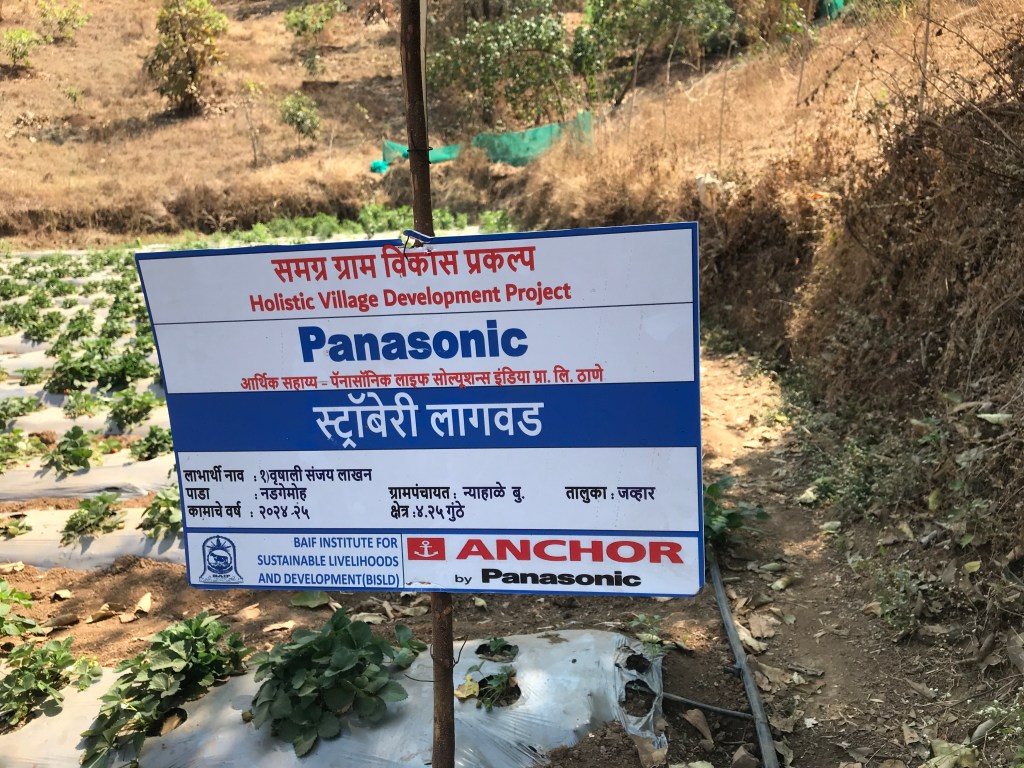
The final day was rounded off by visiting the BAIF livelihood centre in Jawhar. The marketing officer encouraged me to observe their Holistic Village Development Project by visiting the farm of Chintaman Tai in Nadgemoh village, Nyahale Bhudruk Gram Panchayat. BAIF supported Tai through several initiatives, including strawberry cultivation, Jasmine cultivation, the Wadi (horticulture) project, and the construction of a farm pond as part of an integrated watershed management plan. The scale and execution of the projects showcased the extent to which support has to be provided to encourage multi-cropping and integrated farming, the extent to which I had previously underestimated during my previous endeavour. Combining several initiatives to ensure farmers receive multiple benefits (through various projects) and ensuring that several farmers receive collective benefits (via Shared watershed management through farm ponds) are aspects that need to be envisioned and scaled during the planning stage itself. This will ensure that farmers receive the maximum benefit from the initiatives. Another arduous 2-day journey back to the project location of Toranagallu capped off this exposure visit.


Reflecting on the visit, I am filled with a sense of anticipation to apply the practices and lessons learned immediately to my project location. It is enlightening to see the extent to which organisations in the Indian development sector take steps to ensure that sustainable projects are carried out, even in the most remote areas. Looking back at the visit, I fondly reminisce about the incredible extent of learning I was able to glean from this experience, and I am eager to put this knowledge into action.
I would like to express my heartfelt gratitude to Mr Kishor G. and JSWF Fellows Abhishek Sagar and Vivek Shahare, who played a significant role in making this experience immensely rewarding from an educational perspective. Their guidance and support were invaluable, and I am deeply appreciative of their contributions to this journey.
 iVolunteer Blog - everything about volunteering