
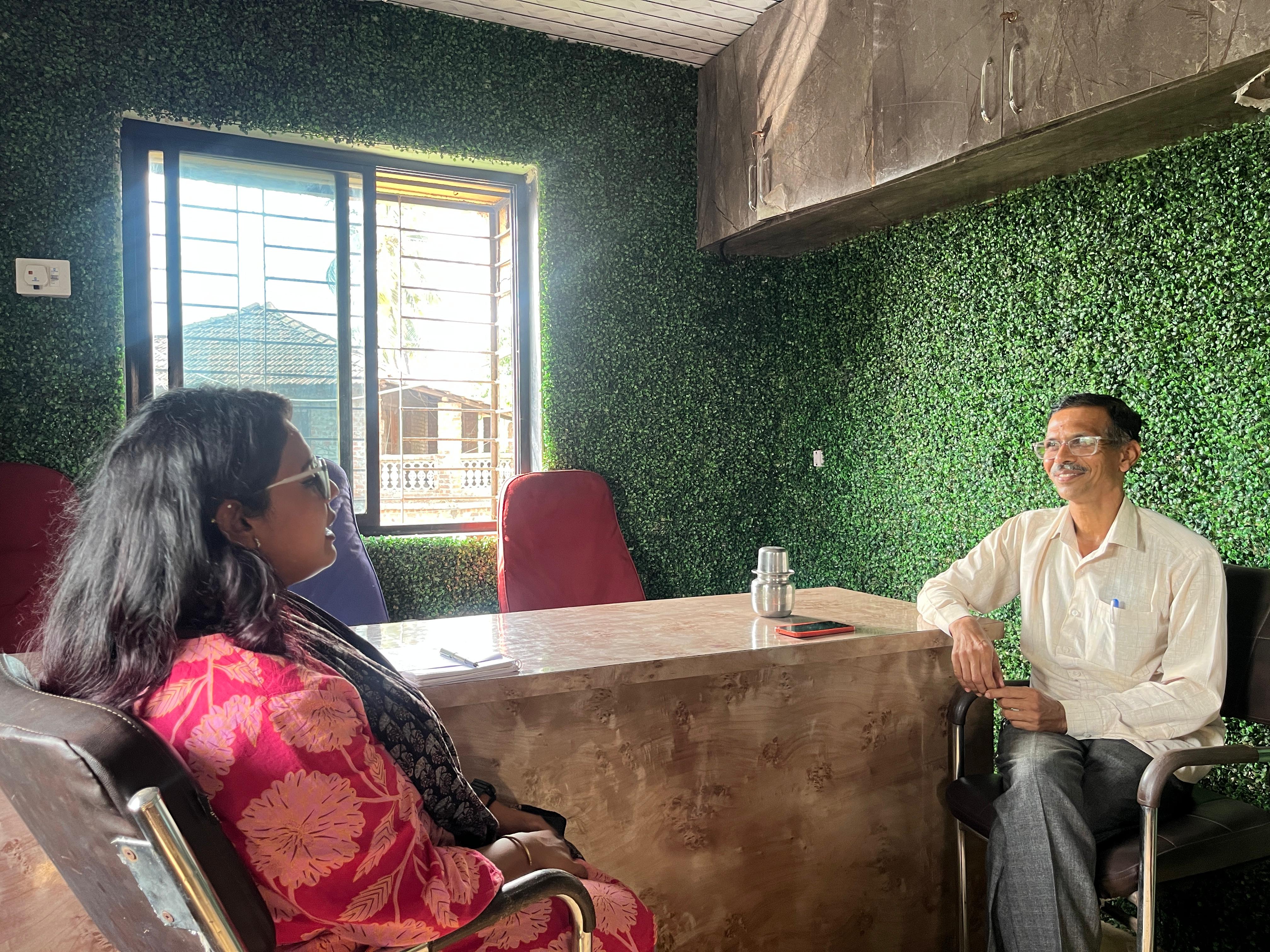
On a recent village visit, I met someone truly fascinating, a great talker I couldn’t resist interviewing. With a grin, he said, “I’m always ready to share, but no one ever asks the right questions!” Interestingly his quiet best friend sat beside him the whole time, saying nothing, but somehow making the conversation even more fun. Read on to learn about his quirky ideas and his take on life.
In the quiet village of Karavi in Pen Block, Raigad, Maharashtra, lives a man with a broom in one hand and a sapling in the other. Dinesh Tukaram Mhatre, 48, is not your typical Gram Panchayat member. He’s a dreamer, a doer, and most importantly, someone who believes that change begins at home, quite literally.
A native of Pen, Dinesh studied till the 12th standard in Chembur, Mumbai, before returning to his roots. For the last 9 years, he has been actively involved in community service, and for the past two years, he has officially served as a member of the Karavi Gram Panchayat. His goal is clear and unwavering: to make Karavi a model village, clean, green, and vibrant.
“I don’t expect the whole village to join me,” he says with a laugh. “If they do, great. But even if I’m the only one, I’ll still keep going.” And go he does, with energy and ideas that could tire out someone half his age.

Cloth Bags, Composting & Chikki Diplomacy
Dinesh ji is on a mission to make Karavi an ideal Gram Panchayat — clean, green, and aware. Supported strongly by the JSW Foundation, he has rolled out several small but impactful initiatives. One of the most heartwarming is his project to turn old sarees into cloth bags to store dry waste. He and his wife stitched and distributed them free of cost to the village women.
But what really sets him apart is his door-to-door awareness campaign — not with flyers, but with chikki, the sweet combination of peanuts and jaggery. “Even if people don’t want to listen, I give them chikki. Everyone smiles, and some end up listening to what I have to say about waste segregation” He gives chikki to those who participate in his campaigns, and even to those who don’t. “Sometimes a sweet treat works better than a serious speech,” he grins.
An active social media user, Dineshji creates videos on household waste management, composting, and gardening, showing how he walks the talk. He strongly believes that personal discipline is the foundation of change. A committed yoga practitioner, he says, “Only if I’m fit can I inspire others. Health is key to transforming the world.”
A Life Mission: 1 Lakh Trees
Dineshji has set himself a wildly ambitious but deeply meaningful goal: to plant one lakh trees in his lifetime. And he doesn’t mean ceremonial tree planting. He ties trees to life events.
“When a girl in our village got married, I gifted her a tree to plant at her new home. Her family says they feel her presence every time they see it. It’s emotional.”
He adds with seriousness, “When there was a murder in Alibaug, a large protest march was held. I thought, what if each person planted a tree in that boy’s memory? That would’ve been such a powerful tribute.”
His passion comes from childhood experiences. “Back in college, bottled water seemed like a ridiculous idea. Today it’s the norm. If we don’t plant enough trees now, we may be buying bottled oxygen tomorrow,” he warns.
His love for trees, he says, comes from his mother, lovingly called a “paudha chor” (plant thief) in the family. “Wherever she’d go, she’d quietly pluck a stem of a plant she liked and bring it home. We’d joke that she’d get us into trouble one day!”
Cleanliness and Gender Roles
Coming from a home where his father helped with cleaning the house, Dineshji believes that cleanliness is not just a woman’s responsibility. “It comes naturally to women, yes, but that doesn’t mean men shouldn’t help. I clean, I cook, and I encourage all my friends to do the same. They laugh, but I tell them – a happy wife means a happy life!”
Challenges on the Road to Change
Ask him about the biggest challenge he faces and he smiles, “Myself.”
He explains, “I start many initiatives but find it hard to stay consistent, especially when the support from society isn’t there. It’s disheartening sometimes.”
And yes, he funds most of his projects from his own pocket, something his family finds difficult to understand. But his resolve? Unshaken.
If He Were 25 Again…
“I’d be more tech-savvy, definitely,” he says. “But more importantly, I’d take better care of my health. Physical and mental fitness are the foundation of everything. Yoga, good food, and a clear mind can help you achieve any goal.”
His Message to the Youth
“Vyasandheen addiction is dangerous, whether it’s alcohol or mobile phones, addiction destroys. Develop your skills. Eat healthy. Move your body. Do yoga or go to the gym. Don’t sit idle. Laziness is more dangerous than an atom bomb.”
Vision of an Ideal Village
To Dinesh, an ideal village isn’t just about concrete development. It’s about harmony and health. “It should be clean and green, with proper waste management and drainage systems. People should be engaged—doing business, farming, something productive. That’s how we avoid problems like addiction and unemployment.”
As his story unfolds, you realize that Dinesh Mhatre isn’t just working on waste or trees. He’s nurturing a culture of responsibility, one sapling, one chikki, and one clean corner at a time. And in that journey, he’s not just transforming Karavi village, he’s inspiring everyone around him to do the same.

 iVolunteer Blog - everything about volunteering