ASHA has Sanskrit roots that mean ‘hope.’ It also has an Arabic origin that means ‘Alive and Healthy. Asha can be translated into various meanings, including ‘happy,’ ‘life,’ ‘wish,’ and ‘desire.’ In term of medical and health ASHA signify as; – “Accredited Social Health Activist”. One of India’s most successful community health initiative programs, designed to bring primary healthcare services to the doorstep of rural populations. This program launched under the National Rural Health Mission (NRHM) in 2005, Accredited Social Health Activists (ASHA workers) play a crucial role in bridging the gap between marginalized communities and the formal healthcare system.
Expansion under the National Health Mission1 (NHM)
In 2013, the NRHM was included as sub-summed into the broader National Health Mission (NHM), where the sole purpose was to expand ASHA’s responsibilities beyond maternal and child health. This inclusion include engagement of these grassroot health workers under NCDs (non-communicable diseases), hygiene & sanitation, and India’s nutrition programs.
Few Major Milestones Achieved includes: –
- 2005: Launch of these ASHA program under NRHM
- 2010: Introduction of performance-based incentives for ASHAs
- 2013: Expansion under NHM to include non-communicable diseases
- 2020: ASHA workers played a crucial role in COVID-19 awareness and vaccination efforts
Brief history and evolution of the ASHA Program
The ASHA program was introduced in 2005 under the National Rural Health Mission (NRHM)which aimed to improve healthcare access in rural India. Recognizing the shortage of medical professionals in villages, the Indian government envisioned ASHA workers as community-based health activists trained to deliver primary healthcare services.
- An ASHA is a local woman (age 25-45 years), preferably married, widowed, or divorced, with at least Class 10 education. NHM considers them volunteers, limiting their earnings to task-based incentives.
- ASHAs serve mainly one per 1,000 people population at the village.
One of the key components of the National Rural Health Mission is to provide every village in the country with a trained female community health activist ASHA or Accredited Social Health Activist. Selected from the village itself and accountable to it, the ASHA will be trained to work as an interface between the community and the public health system.
Key Responsibilities of ASHAs:
- Ensure antenatal check-ups, and postnatal care, while educating mothers on breastfeeding and infant nutrition.
- ASHAs support immunization, tuberculosis (TB) treatment, malaria screenings, and disease prevention.
- Additionally, they provide basic healthcare, essential medicines, first aid, and report births and deaths.
- They would be the first point of contact for any health-related demands of deprived sections of the population, especially women and children, who find it difficult to access health services.
- ASHA will be a health activist in the community who will create awareness on health and its social determinants and mobilise the community towards local health planning and increased utilisation and accountability of the existing health services.
- ASHA will provide information to the community on determinants of health such as nutrition, basic sanitation & hygienic practices, healthy living and working conditions, information on existing health services and the need for timely utilisation of health & family welfare services.
| Picture courtesy by Abhishek Sagar JSW Foundation Fellow, Jawhar, Maharashtra |

ASHA worker’s monthly meeting at Ayushman Aarogya Mandir-Jamsar
Challenges faced by ASHA worker at the grassroot level
- Lack of regular knowledge and skill development
- Delayed salary and incentives as per the work load
- Additional work on field including health survey
- Rarely IEC supported during the field work
ASHA Workers at Health facility gram village-Jamsar, Taluka- Jawhar, Maharashtra
Aayushman Aarogya Mandir, Jamsar cater a population of around 50,000 from the rural tribal community of village Jamsar for providing health services. it consists a team of medical grassroot staffs and allied health professional for delivering the quality of health benefits to the patients. It also monitors all 7-9 health and wellness centers located at different padas or sub-villages for health services availability at community level. The health facility is running government health programs but still at the grassroot level our health staffs need skills, and regular training. In the context of ASHA workers capacity building as per the government health program like- National Tuberculosis Elimination Programme, National Leprosy Eradication Programme, National Programme for Prevention of Non-Communicable Diseases etc should be done regularly as per the field and community level intervention.
During my ongoing JSW Foundation Fellowship journey duration here at Aayushman Aarogya Mandir, Jamsar. While working close with the grassroot health staffs mainly the Accredited Social Health Activity (ASHA) and Multi-Purpose Worker (MPW). What, I observe is that, there were very few skills enhancing capacity building session conducted for ASHAs. While interacting with some of them, few common points came across was; there were rarely frequent health workshops, and skill’s training conducted for them. Some ASHA workers said- for the filed requirement only the orientation was provided, no specific health programmes-based training was provided. New recruited ASHA workers said after they joined as ASHA at that time only any capacity building session was conducted for them. But no such training was provided as per specific health programmes like National Tuberculosis Elimination Programme (NTEP). During my JSW Fellowship project I worked to capacitate 61 ASHA workers of Aayushman Aarogya Mandir, Jamsar for new information and changes occurred under NTEP, TB Mukt Panchayat indicator, and identification of hidden TB cases in the community. some new health intervention regarding preventive measures adopted against TB, and safe sputum collection cum transportation from field to laboratory.
ASHA Workers can be empowered more through;
- Skill Development: Offer training programs for ASHAs to upgrade their skills and transition into higher healthcare roles (e.g., Auxiliary Nurse and Midwives).
- Financial Security: With rising expensiveness, ASHA workers need financial security in the form of fixed regular salary alongside incentives for ensuring financial stability. While, Direct Benefit Transfers (DBT) prevent payment delays, empowering them to focus on healthcare without financial distress.
- Continuing Education and training: their educational status will be enhanced through developing the option of educational resource agency in the district (preferably an NGO) will be identified by the State. The resource agency in collaboration with open schools and other appropriate community health distance education schemes helped to get certification to pursue higher education.
- Periodic Trainings: periodic re-training will be held for about, once in every alternate month at appropriate level for all ASHAs. During this training, interactive sessions will be held to help refresh and upgrade their knowledge and skills.
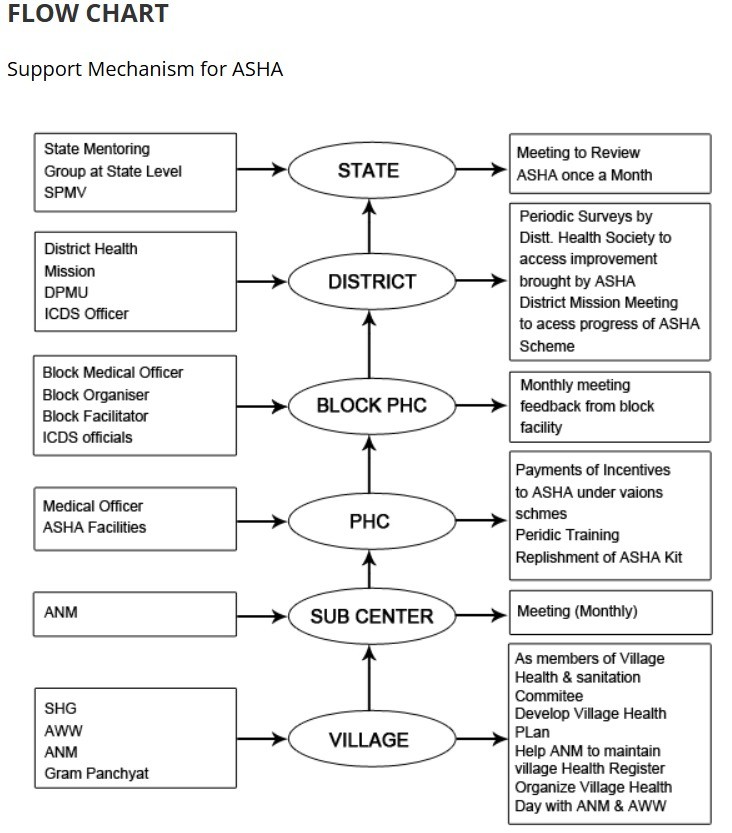
Support mechanism of ASHA[1]
 iVolunteer Blog - everything about volunteering