Understanding the governance system is fundamental for any individual willing to contribute to the development sector. As one of the primary established systems, government hierarchies exist to disseminate benefits for the local populace. With several schemes established, such as the National Rural Employment Guarantee Act, and ample funds available, such as the District Mineral Foundation, sometimes all that is needed is to approach the right person.
First and foremost, gaining an understanding of the hierarchy of needs is crucial. In academic terms, the basic needs of the local populace form the core of this hierarchy. Layers exist around these needs to facilitate their availability and accessibility to the people.

Initiatives are typically designed around the elements of the hierarchy of needs. Conducting Participatory Rural Appraisal (PRA) activities, surveys, and focus group discussions are not just methods but excellent tools for identifying needs, defining the exact problem statement, and then drafting proposals to address the identified needs.
Villages are governed through a Panchayat governance system, as per the 73rd Amendment Act of 1992. The Elements of the 73rd Amendment Act in 1992, which caused Village Panchayats to focus more on Centralized Governance, are listed below (Kindly note that terms and rules might be different in different states):
- Compulsory 5-year elections must be held for every Panchayat.
- 50% Reservation for women for ordinary and executive positions exists. The remaining 50% is open to all genders.
- Combined, 22.5% reservation across all positions exists for SC/ST individuals (15% SC, 7.5% ST).
- Financial Support will be provided to Panchayats by a Centrally appointed Finance Commission. Further income areas for Panchayats are – House Tax, Water Tax, Service Tax, Property Tax, FPOs and SHGs. Panchayats must be financially independent.
- 3 Tier System of Panchayats will exist in all states.

- Constitutional status has been given to the 3-tier system, implying that all three levels of the Panchayat system must abide by the Indian Constitution.
- At least two mandatory Gram Sabhas (assembly of villagers) must be held by the Gram Panchayat annually. The Gram Sabha will consist of all members above 18 years old, eligible to vote and whose names are on the voting list.
- Panchayats must prepare the GPDP (Gram Panchayat Development Plan) by conducting PRA activities and understanding the local needs. Funds would be allotted to Gram Panchayat only based on the GPDP. The District Planning Committee must approve all projects that come from Gram Panchayat.
This implies that the Panchayat system is adequately strengthened through the provisions of the Consitution of India. The nomenclature and funding allocation policies may differ across states; however, the overarching structure remains consistent.
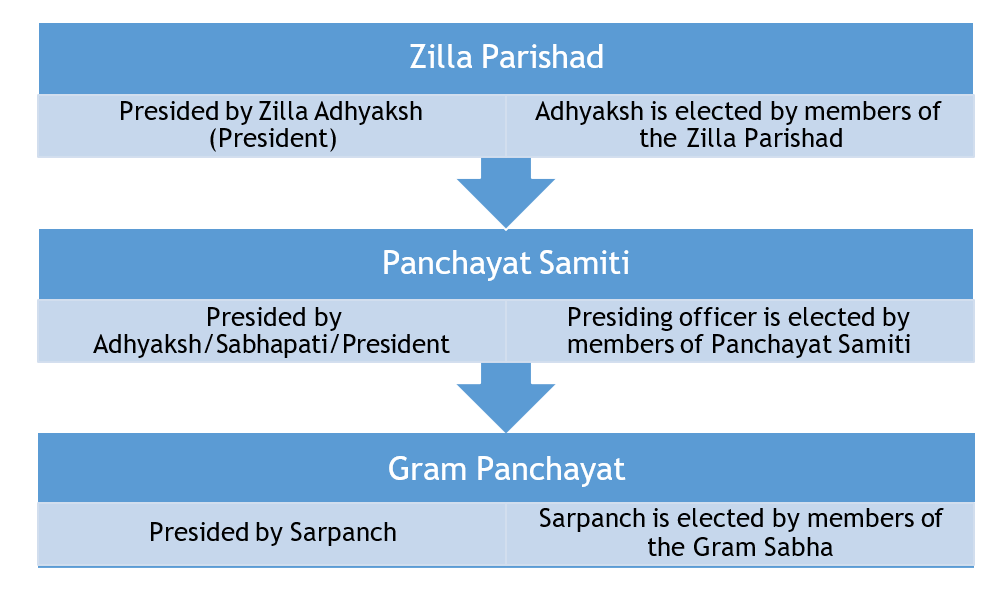
The detailed breakup of the three-tier setup is given below. The breakup consists of three sections: the legislative system, which comprises lawmakers responsible for making laws and policies at the local level; the bureaucracy, which includes secretaries appointed by state and central bodies to implement these laws and policies; and revenue administrators, who oversee the distribution of funds throughout the three-tier panchayat system.


Participatory rural appraisal is considered fundamental as a method for conducting a needs analysis of local situations. It aims to empower locals by sharing their knowledge and analysing their existing situation, enabling them to identify issues through active participation. It’s crucial to note that the outcomes of PRA activities must be cross-checked against multiple sources and thoroughly analysed. This rigorous process ensures the reliability of the information gathered.
Some of the methods that exist to conduct PRA activities are as follows:
- Transect Walk – Preliminary systematic walk through the village with the community.
- Social Mapping – Detailed village map to understand geography, demography, community distribution, and landmarks.
- Timeline Mapping – Mapping the history of the village and significant milestones which shaped the current village.
- Seasonal Mapping – Understanding agricultural patterns, financial commitments, and migration.
- Venn Diagram – Learning about critical issues of the village and where the village currently stands on these issues.
- Wealth Ranking – Understanding rural economies and how they represent and influence rural workings.
- Observing Social Institutions – Visiting the existing facilities in the village and attending their functioning.
Gaining an understanding of the system we work with ensures that we can optimize resource utilization and generate greater public participation, and hence support for initiatives we desire to execute.
I would like to thank Dr. Ramesh Jare, Professor at Tata Institute of Social Sciences (TISS), Tuljapur Campus for conducting a wonderful session and imparting this knowledge to the JSW Foundation Fellows.
 iVolunteer Blog - everything about volunteering