
A Melodious Tale of a Copper Bell from the Village of Nirona (Kachchh, Gujarat, India)
In our world, a rich tapestry of crafts and art flourishes, each uniquely designed to captivate the senses and fulfill various purposes, from decoration to exhibition, entertainment, and social interaction. Each form of art mirrors the diverse aspects of human existence, enriching our lives and fostering connections that transcend time and place. Every crafted piece in this vibrant landscape of expression is a testament to the beauty of creativity and the shared human experience.
You know, every art form and every artist has their own stories. These stories encompass the essence of creativity, weaving together themes of personal livelihoods, moments of joy, and the inevitable challenges they face. They reflect the sense of togetherness found in collaborative efforts and the prestige that often comes with recognition. Each tale is a collection of experiences, emotions, and inspirations that shape the artist’s journey and influence their craft. And today, I will share my story with you.
Hello! I am “Ghantadi,” called in Kachchh, Gujarat, and more commonly known as the “Copper Bell”. You might have heard me or seen me tied around the necks of cattle. I am a unique craft originated for cattle rearing, and some people believe we were first crafted thousands of years ago in Sindh, which is currently in Pakistan. I am created from iron sheets, with the metal parts joined together without any welding. There are thirteen types of Copper Bells, each customized for different animals. For example, a goat will have smaller bells that produce a high-pitched sound, while a cow will have larger bells that emit a deeper sound. In addition to being used for cattle, I am also customized for display in homes because of my handcrafted design and melodious sound. I am even used to sound therapy. It’s important to mention that my fellow bells and I are exclusively produced in the village of ‘Nirona’ in Kachchh, Gujarat, India, which is our birthplace. I was crafted by ‘Yakub Bhai’ and his family, who have been crafting me and earlier versions of myself for many generations. There are only a few families who possess the skill to craft copper bells like us.
Let me take you through our making:
While the men of the house, who are blacksmiths, work with iron pieces to make the bells, the ladies of the house are responsible for polishing the bells using a mixture of mud and copper powder. First, Yakub Bhai takes a rectangular strip of iron and manually hammers it into shape, folding it into a cylinder and securing the open ends. Next, he cuts another strip of iron into a circle that is larger than the base of the cylindrical piece he created earlier. This circular strip is then continuously hammered and shaped into a dome, resembling an inverted bowl.
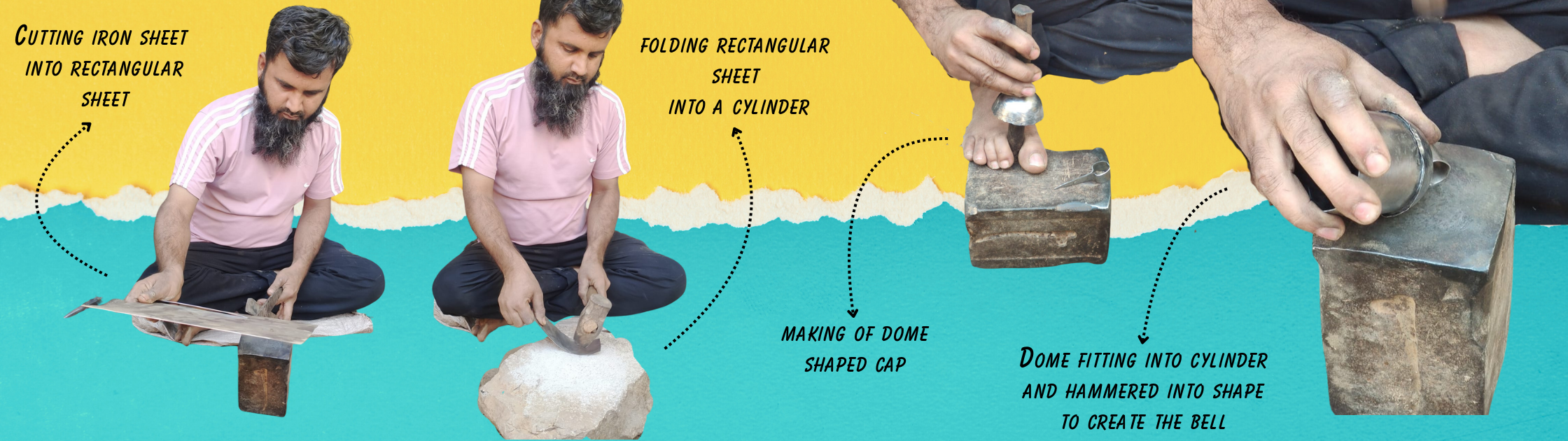
Once the dome is formed, it is fitted onto the cylinder and also hammered into shape to create the bell. A thin strip of metal is then used to create the loop at the top of the bell. The two ends of this strip are inserted into the top of the dome to form the loop, while the open ends inside the bell are twisted to create another loop.
This process involves several important steps to achieve a polished finish. First, they will dip us in a mixture of mud and water, after which a blend of brass and copper powder is applied to our surface. This metallic powder adheres to the bell, which is already coated with the thick mud-and-water solution. Next, chunks of cotton that have also been dipped in the mud-and-water solution are flattened like cakes and wrapped around us. This work is primarily carried out by women at home. After the wrapping is complete, we get baked in a traditional country oven powered by wood or coal. The baking duration varies depending on the size of the bell, typically ranging from 30 minutes to about 2 hours.

Once baking is finished, the cotton coating and any excess mud are removed from us, resulting in a golden, lustrous appearance. Finally, a small piece of locally available wood is inserted into us after it has been polished with brass and copper. To hang us, this wooden piece is pierced on one side and fitted with a narrow iron hoop. Look at us, the beautiful and with musical notes.
What happens after our making:
We are crafted in thirteen different sizes. These are customized for different animals. For example, a goat would have a small size of us with a high-pitched sound, while a cow would have a larger size with a deeper note. Sometimes, even if we can be the same size to sound different by changing the dent made near our rim. This helps in differentiating the cattle of different owners. In each size, up to five or six different notes can be made.
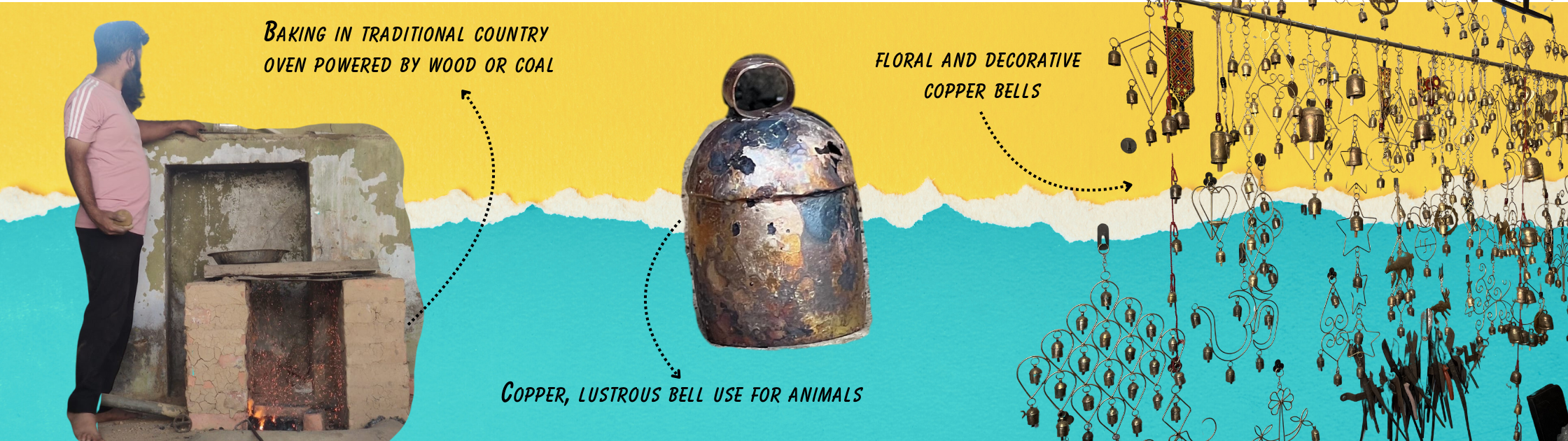
‘Ali Bhai’, the elder brother of ‘Yakub Bhai’, owns a shop called ‘Copper Bell Art’ in our village, Nirona. In his shop, he showcases us so that those who love us can take us home or give us a space to sing our melodious tunes. He also takes us to various exhibitions all over the country. The craft of making us is over a thousand years old and is believed to have originated in Sindh, now in Pakistan. It was popular among nomadic pastoral tribes who adorned their cattle with bells of distinctive sounds, helping to locate wandering animals. The bell makers, from the Lohar caste in Kutch, have a lineage tied to this craft. In India, communities have a strong bond with animals, celebrating them through festivals like Govardhan Puja and cattle fairs. Over time, as these tribes settled in the Banni region and adopted a more sustainable lifestyle, our use has evolved from practical cattle alerts to contemporary decorative items.
No two of my cousins are alike, and they each represent the themes of sustenance, creation, and a love for life, enhancing our rustic charm. Smaller versions of our creations, featuring geometric, floral, and other designs, have become quite popular. Our use of cattle has decreased as the tribes have transitioned from a nomadic lifestyle to settling down.
The skilled artisans who once crafted me, along with countless others, have pursued new opportunities, leaving behind a legacy that is both rich and challenging. The constant demand for revamping and reimagining traditional art forms has created significant obstacles in today’s market. Yet, two dedicated craftsmen, Yakub and Ali Bhai, continue this age-old practice with unwavering commitment. They face numerous struggles, including lower demand for their intricate works and setbacks caused by the disruptions of the COVID-19 pandemic, which affected their ability to reach customers.
Despite these challenges, they express profound gratitude for the decision they made to dedicate their lives to this craft. They often reflect on how their work not only sustains them but also has the potential to support future generations. This connection to their heritage and their community gives them purpose. I take great joy in knowing that, even as a small figure like me—a ‘Copper Bell’—I can play a role in their journey, contributing to their livelihoods and the preservation of a beautiful tradition that enriches the lives of many.
I hope you enjoyed my story! If you did, I would love for someone like you to have me as a part of your home. I would enjoy decorating your space and singing melodious tunes for you. Please consider visiting our village, Nirona, and meeting my creators, Yakub and Ali Bhai, along with their family. They are my family and my makers, who shaped and beautified me before handing me over to wonderful people like you.


 iVolunteer Blog - everything about volunteering