
12 February 2025
I am a fellow who lives proudly in a village with very minimal facilities and basic resources. The village I am living in is located at the foothills of a mountain called ‘Sorakka malai’. There is only one provisional store (kirana store) for the entire village. It means one has to plan everything beforehand. I used to always carry a list of things I needed to buy whenever I traveled to the nearby town. I had to face the consequences when I forgot something. This taught me how to work with very minimal resources and how one can solve situations creatively. This also taught me to ask for help without hesitation.
As I used to live in the city, I had always been told to be independent. Seeking for help is considered a weakness in many ways. But, I have understood that it is more challenging to ask for help than to be independent. Let me share one of my experiences here.
I was living in a house where the house owners, Saminathan and Manimekalai, lived in their daughter’s house in Dharmapuri. They decided to come back to the village when Saminathan fell ill. They wanted to avoid becoming a burden to their daughter and it meant I have to move out.
I started looking for options in and around the entire panchayat. That’s when I was told about a vacant room in Chellammal’s house. It was located right next to the house I was already living in. I checked out the house. It was a small 10×10 ft room and the kitchen was attached outside.
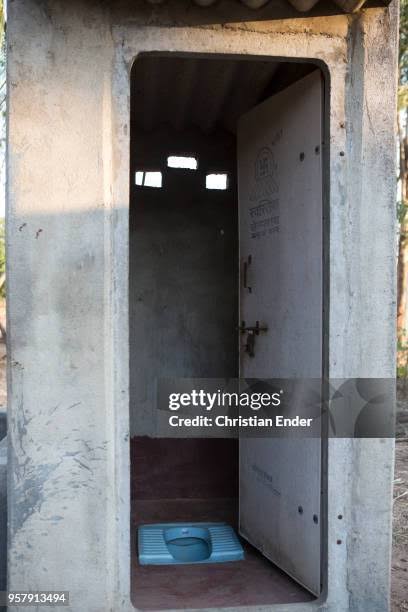
One problem was a roofless bathroom and the other problem was the absence of a toilet. Chellammal was a 92 year old who was well-accustomed to open defecation. Now, I had to face this challenge because I couldn’t find another place within the said deadline and within my budget. So, I decided to strike a deal by seeking out for help from my previous house owners. I kept fulfilling their asks and requests for day-to-day activities. I even went to the hospital with them for an emergency check-up when their son and daughter couldn’t come. All this in return for using their toilet.
Interestingly, the toilet was situated out of the house. It seemed more comfortable than walking into their house every time I had to access the restroom. After a formal request and their half-hearted acceptance, I had a deal to stay at Chellammal’s house, adjust with a roofless bathroom and use the neighbor’s toilet. I felt super good about the entire arrangement as it all came at a cost of 1500/-.
This is where I learned the concept of common resources and the challenges associated with it. Life is a cycle of ups and downs. A privileged person can become unprivileged and vice-versa, anytime.
I grew up with all the basic amenities and more in Chennai. But now, I am constantly being careful and overly conscious about sharing the resources. It isn’t just the toilet, but also resources like water, toilet light and even the space in which I walk to the toilet. I had to think about what they would think, the timings, frequencies, sound, odor, etc. Sooner, I realized, it isn’t just about using the restroom but about me, as an individual. I had to struggle and make small casual talks every time I walked to the restroom.
To avoid such awkward small talk, I planned my loo breaks carefully around the times they were either inside their house or went out for work. But, Saminathan was always present and expressed an evident resentment about this arrangement. He was worried that the sump might overflow and I would refuse to share the expense. Sharing the toilet with a stranger who came from the city was all too difficult for him to accept. He stopped talking to me as well. That’s when I realized the level of difficulties individuals and communities face when they share spaces and resources.
While I was discussing this entire situation with my father, he shared his experiences in Dharavi. Dad used to travel a lot in his 30s and 40s. Whenever he visited Mumbai, he used to stay in Dharavi to cut expenses. He remembered how the toilet system in the world’s largest slum works. The system established in Dharavi made the concept of common toilets possible. Dad still remembers how clean the toilets used to be. He said the locals used to clean it every two hours once. Listening to him, I realized the importance of having an arrangement or a system in place. Sometimes, the systems may fail as well. However, to right a wrong, a wrong must be there. I believe having a flawed system is still better than having no system.
Readers might now ask how it helps my situation. It wouldn’t have, until I took measures to establish an arrangement.
I returned from the Bhuj travel workshop, and applied one of my key learnings. I decided to take action, no matter how small it is. I went to Saminathan and Manimekalai’s house and sat in front of them. I stated that I have six months left in the fellowship and I will have to move out of this village only because of the toilet issue. I also expressed my liking for this community and how I feel at home with all of these lovely people. I then asked whether it would be alright with them if I used their toilet. I also committed to sharing the expenses related to it. Listening to me carefully, Mani amma said, ‘It’s completely fine. Don’t you worry about it. Focus on your work.’ While I wasn’t expecting an excited response from Saminathan, he nodded in agreement with Mani amma.
A simple explanation and a straightforward question is all it took to resolve the challenge. Like always, mom and dad were right to guide me in this direction. I’m now excited for the remaining six months in Malaiyadipatti.
“The sharing of goods and resources from which authentic development proceeds, is not guaranteed by merely technical progress and relationships of utility, but by the potential of love that overcomes evil with good.” – Pope Benedict XVI
 iVolunteer Blog - everything about volunteering