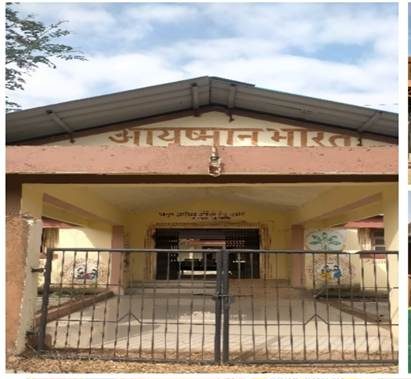
The story started during the transit walk of my gram panchayat- Jamsar, Taluka- Jawhar. The beautiful geography of tourist spot place- jawhar in the district- Palghar, Maharashtra. There is Aarogya Vardhini Center/ Health and wellness center (HWCs)/ Sub-Centre at the village Vadpada. The HWCs cater basic healthcare services of grassroot level through its dedicated health staff’s team.
A health sub-centre is the most peripheral and first point of contact between the primary health care system and the community. A Sub-centre provides interface with the community at the grass-root level, providing all the primary health care services. As per population norms, there shall be one Sub-centre established for every 5000 population in plain areas and for every 3000 population in hilly/tribal/desert areas.
Sub-centres are provided with basic drug for minor ailment needed for taking care of essential health needs of men, women and children. The Aarogya Vardhini Center/ Health and wellness center, or let’s say, the grass-root level of primary health care system in India serves as the link between the community and the health care system. Usually, there are about 6-10 Sub-Centres under every Aayushman Aarogya Mandir/ Primary Health Centre (PHC).
History of primary health care
According to Alma- Ata, Declaration primary health care is broadly defined as ‘essential health care based on practical, scientifically sound and socially acceptable methods and technology made universally acceptable to individuals and families in the community through their full participations and at cost that the community and country can afford to maintain at every level of their development in the spirit of self-reliance and self-determination’ (WHO-UNICEF, 1978). Health care has the following three tier pattern.
- Primary health care: this is the essential health care provided at the first level of contact of the individual or the family with the national health system.
- Secondary health care: this refers to an intermediate level of health care where specialist facilities are available to deal with complex health problems referred from the primary level.
- Tertiary health care: this is the highest level where super specialties are available, and, sophisticated investigating and therapeutic procedures can be performed.
By last quarter of the 20th Century, it had become clear that poor living conditions, low literacy, poverty, and inability to take decision regarding one’s health were major impediments to health. These improvements in health could not occur without simultaneous improvements, in social and economic conditions. A level of health that would permit individual to lead a socially and economically productive life. This came to be popularly known as the “Goal of Health for All by 2000”. As a follow up, the International Conference on Primary Health Care in 1978 held at Alma-Ata. The conference identified primary health care as “the key to achieving an acceptable level of health” as part of social development and social justice” in the community. Primary health care has been defined as the essential health care which is close to the people, where most of their health problems can be dealt with and resolved.
Various Health care institution/facilities present at Taluka- Jawhar
| Taluka level | Sub-District Hospital |
| Gram panchayat level | Ayushman Arogya Mandir/ Primary Health Centre/ |
| Village/pada level | Aarogya Vardini Kendra/ Health and Wellness Centre/ Sub-Centre |
Introduction of Aarogya Vardhini Center/Health and Wellness Centre- Vadpada, Jawhar
Thehealth and wellness center (HWC), Vadpada also called as “Aarogya Vardhini Center- Vadpada” cater a total population of 3703. The center eloped around the 06 padas and 03 revenue villages of gram panchayat Jamsar with majority of the tribal community. In these areas mixed tribes of Warli, Kaatkari, Koli, K. Thakur, and Konkani resides. These people are mainly earning their livelihood by doing agriculture, driving, doing small businesses, and manual labour. These people have to go outside their villages in search of work generally except the rainy season. The pada includes 01 ZP school, 02 Aanganwadi center, 01 Health and Wellness Center, 02-03 fishing ponds, and agricultural lands. The village have 02 well and handpumps too. The drinking water facility is available at the village, along with daily bus accessibility to the villagers.
Organogram of Aarogya Vardhini Center/HWC- Vadpada
| Community Health Officer (CHO) |
| Auxiliary Nurse and Midwifery (ANM) |
| Multi-Purpose Health Worker (MPW) |
| Accredited Social Health Activist Worker (ASHA) |
| Caretaker of the Centre (PTA) |
Human resources at Aarogya Vardhini Center/HWC- Vadpada,
| Health staffs/designation | Total number of health staff |
| Community Health Officer | 01 |
| Auxiliary Nurse and Midwifery (ANM) | 01 |
| Multi-Purpose Health Worker (MPW) | 01 |
| Accredited Social Health Activist Worker (ASHA) | 05 |
| Caretaker of the Center (PTA) | 01 |
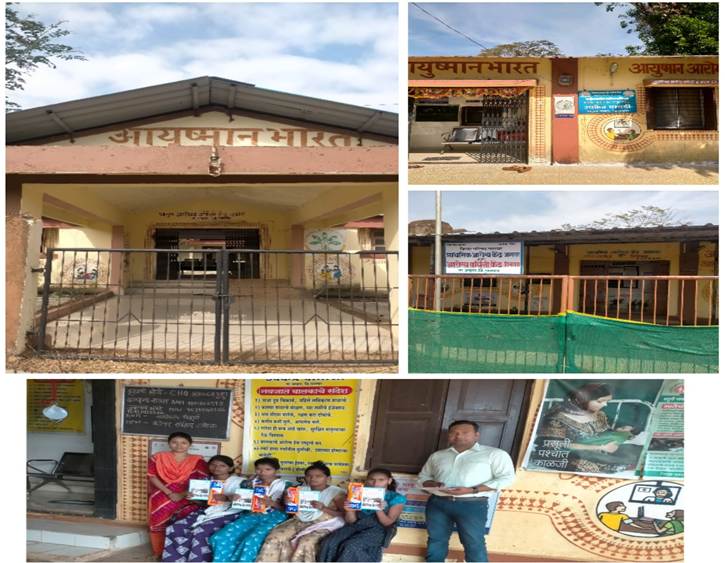
Health and wellness Centre/ Aarogya Vardhini Kendra Vadpada- Jamsar picture courtesy- Abhishek Sagar (JSW Foundation Fellow)
Functions of Aarogya Vardhini Kendra/Health and Wellness Centre, (HWCs), Vadpada
The main purpose of a Health and wellness centeris to act as the first contact point for the community and the Primary health care system. It is the first accessible point for every rural individual to basic essential health care services like;
- Providing basic medical services for the community. Every HWCsis equipped with medical kits containing common medicines for minor ailments.
- Providing maternal services like- Ante-natal, Intra-natal and post-natal care during and after pregnancy with child health services like Immunization, government health schemes benefits, preventive health education to all etc
- Providing family planning and welfare services like contraception distribution, maintaining various registers records- eligible couple registers, birth register, vaccination register etc.
- Providing adolescent health care services- through education, counselling against alcohol and tobacco cessation, practice of safe sex, nutrition information against Anemia etc.
- Providing water and sanitation services like diarrhoea control services like use of ORS, and well chlorination drinking water sources.
- Keeping a close check-up on disease surveillance through regular reporting and filling Syndromic surveillance Form (S-Form) of government’s Integrated Disease Surveillance Project.
- Helps in building up an Interpersonal communication in order to bring about behavioural changes in the community, carry-out government health surveys and actively participate for various National Health Programmes.
- Referral complex cases & treatment to the nearest health facility like- Aayushman Aarogya Mandir/PHC
Health services upgraded at Aarogya Vardhini Kendra/ (HWCs), Vadpada
- Daily Outdoor Patients Department (OPD) consultation for the local individuals.
- Immunization clinic and filed outreach visits once in a week
- Vector borne site/ water logging checking through field visit alternatively
- DOTS/sputum collection monthly
- Electronic Vaccine Intelligence Network (e-VIN) live reporting
- Integrated Disease Surveillance Programme regular reporting
- Introduction of practicing of YOGA for the community
- Celebration of various National health days.
For achieving quality of healthcare and increase awareness on tuberculosis the Aarogya Vardhini Kendra/ Health and wellness centre (HWCs), Vadpada started various community TB awareness initiative, within the various padas/villages under TB Mukt Panchayat with the co-operation of Mr. Abhishek Sagar (JSW Foundation Fellow) working closely with the HWC- Vadpada, and gram panchayat’s Ayushman Aarogya Mandir, Jamsar, Taluka- Jawhar.
 iVolunteer Blog - everything about volunteering