

Some journeys are more than just travel. They are moments of pure magic, deep connection, and unforgettable memories.
On February 2, 2025, the most awaited part of our travel workshop finally arrived. We were off to the road to heaven—White Rann of Kutch and Dholavira.
Seventeen fellows, brimming with excitement, boarded a bus from our hotel in Bhuj, ready for the three-hour drive to the White Rann. The anticipation was palpable. Manish and Anusha, our organizers, ensured we were on schedule, while our facilitators gave us a final reminder to be punctual. Dressed in our best, we felt more like we were heading to a pageant than a desert. A quick stop for a delicious Gujarati breakfast at a roadside stall fueled our excitement. It wasn’t just the food; it was the shared laughter and camaraderie that made it taste even better.
As the bus rolled along, it transformed into a vibrant dance floor. A medley of songs in different languages filled the air, yet we were united by the shared rhythm of joy. We sang, we laughed, and we danced with abandon. Some of my fellow travelers revealed hidden talents, turning out to be incredible dancers. The bus ride became a symbol of our growing bond, transforming us from co-fellows into a close-knit family.
Suddenly, the music stopped. A hush fell over the bus as we caught our first glimpse of the White Rann. Through the windows, the endless expanse of white salt marshes stretched before us, an ethereal vision that looked like a mirage. We couldn’t contain our excitement. The bus came to an abrupt halt, and we rushed out, eager to explore this surreal landscape. The moment my feet touched the ground, I felt the crispness of the air, the crunch of the salt beneath my feet, and the gentle breeze caressing my face. For a few moments, I stood transfixed, absorbing the sheer beauty of the place. It was unlike anything I had ever seen – a vast, pristine land that felt otherworldly.
Then came the next task—photos!
Solo shots, selfies, group pictures—no one wanted to miss capturing this moment. We clicked pictures with Shalabh Sir and Prashansa Ma’am, trying to hold onto every second of this magical place. Some of us even made video calls to family, proudly showing them this new world we had stepped into. But nothing could prepare us for what came next.
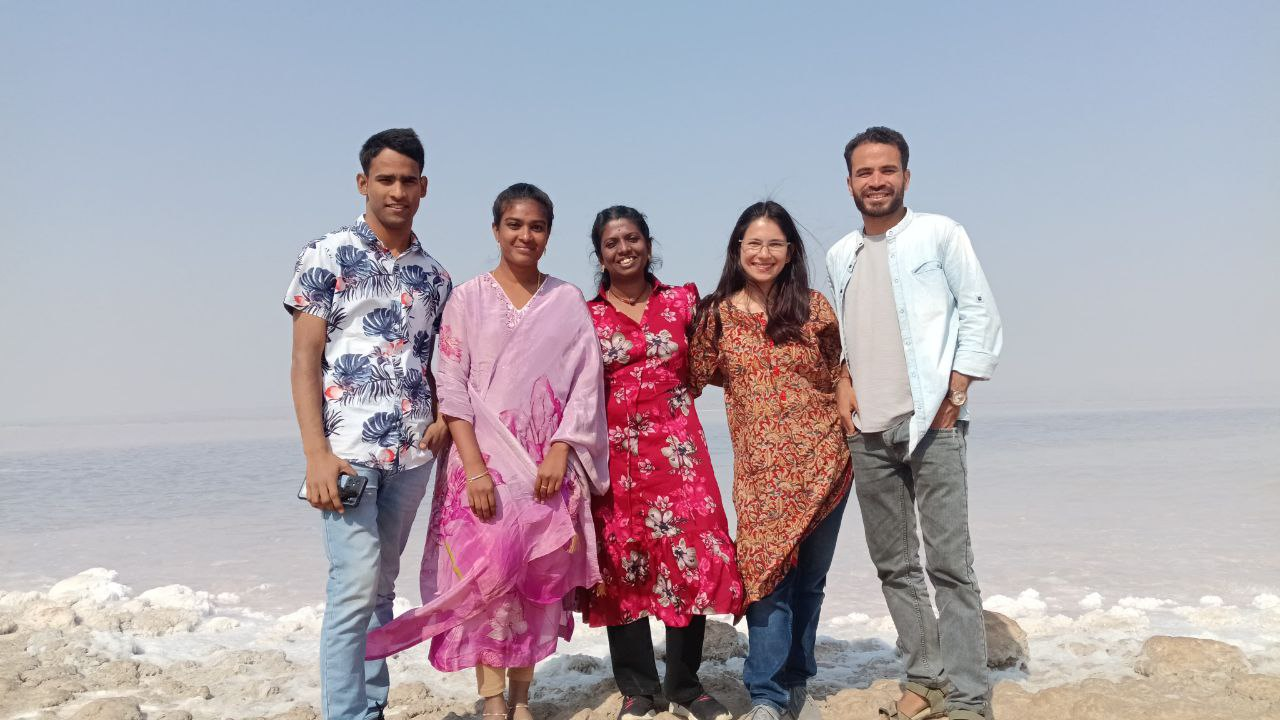
The bus rolled forward and came to a stop at the full White Rann spot. My God. Mind-blowing. For a second, I genuinely thought I was walking on ice. But it wasn’t ice. It was salt. White, glistening, endless. A landscape so pure, so untouched, that it felt like stepping into a dream. People were scattered all around, taking in the beauty, clicking pictures. Everywhere I looked, the scene was glittering.
And then, how could we leave without a group dance?
Dancing on Salt
Sibani choreographed a lively Chaiyya Chaiyya dance, and within minutes, we all learned the steps. Dancing on the salt desert, with the sun setting behind us—it was something out of a movie. Laughter, energy, and pure joy filled the air. It was one of the best moments of the trip.

Of course, I couldn’t miss the opportunity to pose for endless pictures. Thanks to Arfana and Valli for being my personal photographers! And a special thanks to Alina, who captured every candid moment so beautifully.
Sitting on the salt, making random poses, letting go of all worries— it was simply magical. This wasn’t just a place. It was a feeling.
Before reaching Dholavira, we stopped for lunch at a homestay near the site. What a place—calm, peaceful, and full of warmth. The food was delicious, with authentic Gujarati flavors that made every bite enjoyable. The women there wore beautiful traditional attire, adding to the charm of the experience. We even had small interactions with the children, sharing smiles and laughter. But the real highlight? A nap on the cot in the open, breezy space. The cool wind, the quiet surroundings, and the sheer comfort of resting under the open sky made it one of the most peaceful moments of the trip. A simple yet unforgettable experience.
Dholavira – Echoes of a Civilization
Leaving the surreal beauty of the White Rann behind, we journeyed to Dholavira, one of the most significant archaeological sites of the Indus Valley Civilization. The transition from the otherworldly beauty of the Rann to the historical depth of Dholavira was striking. Massive reservoirs, ancient streets, and well-planned structures spoke volumes about a civilization that was far ahead of its time.

Touching the 5000-year-old bricks, I felt a connection to the past. How did they build this in the middle of a desert? What were their lives like? How much knowledge have we lost over the centuries? Standing at the north gate of the city, looking out at the vast landscape, I realized that these ruins were not just stones; they were stories waiting to be told.
Our visit to the Dholavira Archaeological Museum, maintained by the Archaeological Survey of India (ASI), provided valuable context to our exploration of the site. The museum showcased artifacts and historical records that brought the city’s past to life. We learned about Dholavira’s significance as a major Harappan city, its occupation between 3000-1500 BCE, and its advanced water management system, fortified settlements, and ceremonial grounds. The Harappans were master engineers, ingeniously managing water resources in a challenging environment. The museum’s exhibits, including intricate jewelry, semi-precious stones, copper, ivory, terracotta, and shell artifacts, showcased the artistry and craftsmanship of this ancient civilization. Walking through the museum, surrounded by these remnants of history, I felt a sense of awe and admiration for a civilization so advanced yet so connected to its environment.
The road back was bathed in the golden light of the setting sun. After Dholavira, we paused on the “road to heaven,” the Rann stretching before us. As the sun dipped below the horizon, we sang, the melodious tunes filling the air. It was magical, a dreamlike moment. I even sang a Tamil song for the first time before a crowd, feeling completely at ease. In that instant, my fellow travelers felt like family. Then, as the last rays faded, we boarded the bus, hearts full. Kutch isn’t just a place you visit; it’s a feeling.

 iVolunteer Blog - everything about volunteering