
3rd February was the 6th day of our travel workshop. As it is a travel workshop, we travelled a lot even though it was for very short distances. So, some of us like sunrises and sunsets or we like the light and moments at that time. Our day started with the beautiful sunrise at Hamirshar Lake, the beautiful Bhuj. I got to know about the tradition where people do rituals when Hamirshar Lake overflows and the day is declared a holiday for Bhuj. The interesting part is people do not ask how much rain happened this season they ask if Hamirshar is overflowing or not if it then they have enough water of their own this year. This is how beautiful the lake is and the sunrise and birds are like jewelry to the lake. We were five people at the lake, I hope others were in beautiful dreams just like we were in reality.

After coming back, we got ready for our day and around 9:20 we all were ready to bridge our knowledge about Bhuj with the organization called ‘Setu”. After having breakfast near Jubilee Square, we were at Setu’s office around 10:30. We had Dabeli, Poha, Pakoda, jalebi, and tea, the highlight part for me was it was my first Dabeli and I liked it around 60%.
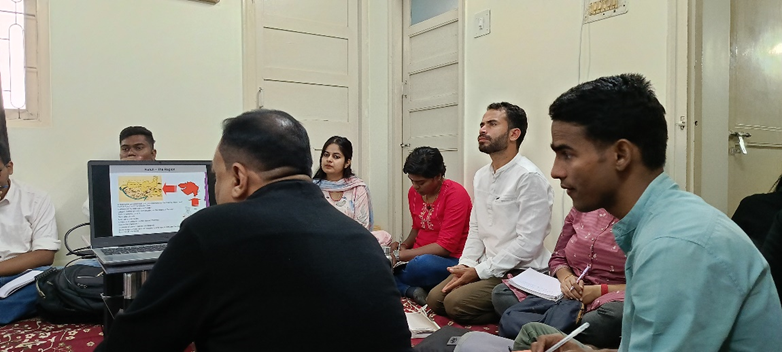
At Setu(A link between the community, the government & NGOs), we met Manish Sir, the facilitator of the session. The first thing that can make you feel interested in their session is their striking voice. Some voices are there to be heard and it was one of those voices. So, we started our session with our small introduction which we do every day in different spaces and the beautiful thing is we are adding 2-3 introductions every time. And this time we got a detailed introduction to Bhuj, Kutch. Kutch is the largest district of India having a semi-arid climate with zone-5 earthquake region. Kutch is called Kutch because when we see the map of Kutch upside-down it looks like ‘Kachua’(turtle).
Kutch has desserts, agri-lands, Wetlands, Grasslands, and the very famous white rann. The agriculture here is rain-fed and dryland agriculture it is called. The rich craft culture of Kutch is the attraction of this place.
As beautiful as the place is, Kutch also is a disaster-prone area, we hear almost every alternative year Kutch faces draught, and every decade an earthquake. This is where Setu comes into the picture as a program for relief from drought. The Kutch Nav Nirman Abhiyan is the umbrella of all the organizations working in Bhuj right now. KNNA focused on developing a rural cadre of youth, and data-driven policy advocacy at the state and district levels on key areas of intervention like primary education, drinking water, and disaster management. The network covered 450 villages in the district and intervened in natural resource management, local governance & capacity building of Panchayati raj institutions, women empowerment, legal aid, micro credit linkage, mainstreaming handicrafts, health, and education.
2001 was the tragedy shaking Kutch all over. The earthquake of scale 7.6 had an epi-center in the Kutch district. 15.5 million people were affected and 19988 lost their lives. A total of 338000 houses were destroyed. These can be numbers in some registers but when you visit the place and then think about this number, you will fear this number. The disaster left the space to be built again, people started rebuilding their lives again. So, from 2001-2004 Setu and the KNNA were walking with the community on this broken path. The intervention area now was wide and very important where Policy advocacy on housing, relief coordination with 156 NGOs, 21651 semi-permanent shelters in 253 villages, 10 minor irrigation schemes & 58 small dams repairing, 7035 permanent shelters in 105 villages, retrofitting of 1506 houses in 47 villages, 43 disabled friendly houses, livelihood support to 63 paraplegics, and 192 work shed reconstruction in 11 villages for artisans was done by the KNNA network.
As told by Manish sir, when the Kutcchi people overcame the earthquake and relief work was done, KNNA had this discussion among them, should they continue with what they were doing, or should they stop? The good thing is they decided to continue.
Setu right now plays a role in facilitating the development program in the village. Setu covers 404 villages including hamlets and reached approx 90,000 houses directly or indirectly and coordinated with 66 voluntary NGOs.
In this journey of Setu, the members realized that the Panchayat which can play a very important role in coordinating every situation is not seen as a part of the development structure. Then a heated discussion took place, decentralization was the focus of the talk. Gram Sabha is the first body to reach out at the community level and most connected with people because the whole structure is made by and made of the local people. The discussion opened new branches and we talked about the 73rd Amendment Act 1992 which shows the vision of participative democracy. There are three tiers of the panchayat, at the village, intermediate, and district levels, seats in every panchayat at every level will be filled by direct election from the respective territorial constituencies. We talked about 29 subjects listed in the eleventh schedule from which 14 subjects have been fully transferred to the panchayat in Gujrat. Understanding Gujrat Panchayati Raj also helped me understand the difference in the Panchayati system in every state, I was really amazed by the fact that the Panchayati work system can differ so much, and after this, I want to understand my village panchayat more.
The discussion took me to my village panchayat and I was trying to connect the dots just like most of us. Fellows asked questions about their experiences and curiosities. The answers were not just detailed but also humorous. If you meet Manish sir, he will tell you how Setu conducted Balika Panchayat voting through a paper voting system not using any voting machines.
The Balika Panchayat was something that attracted most of the attention. It is difficult to go beyond the sanitary napkin distribution by Asha workers and we were talking about an elected body of girls in the village which will take care of all the subjects of women and will raise the issue to the panchayat and more of it they will participate in GPDP. Panchayat and district-level Sarpanch Association is also a step towards strengthening panchayat. The association works as a peer learning platform where they coordinate for policy-level issues at the panchayat level. This group is also for coordination with taluka panchayat and district panchayat to implement GPDP. Setu has been working on the preparation of GPDP for villages and making sure everyone participates in the process.
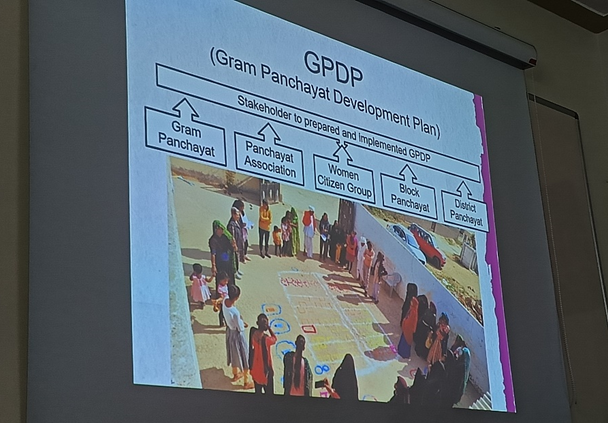
If you want to know about the process it goes like the selection of panchayat, meeting with panchayat, establishing gram panchayat planning facilitation team, ward PRA, village PRA, and data collection with panchayat for village level need, need assessment with occupation group, sharing of plan in Gram sabha for approval, upload passed and prioritized regulation in panchayat meeting on the government portal. The whole information about the village also gets uploaded in software used by Setu and other stakeholders. Setu coordinates GPDP from the Gram panchayat level to the taluka panchayat level to the district panchayat level to the state level through meetings, trainings, workshops, regional consultancy & policy advocacy for GPDP.
To increase the participation of women in the panchayat various training sessions for adolescent girls groups and Balika panchayat get trained on the GPDP process, gram sabha and rules, and government schemes for vulnerable, fundamental rights & duties, child marriage and girls education. To make the process more institutionalized a Panchayat Resource Center through the Panchayat association is established. This platform helps in coordination with Taluka and the district-level department and line department. Government schemes information and circulars for panchayats get circulated from here. Based on Setu’s data 4602 visitors visited PRCs to get services, out of them 1218 got financial assistance of RS72,98,500.
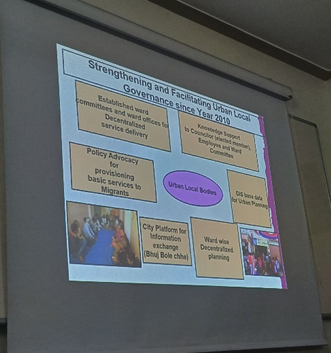
According to the 74th CAA, article 243 S, ward committees are to be formed in all municipal corporations with more than 3 lakh population to bring greater decentralization of functions, proximity of elected representatives & civic administration to citizens, and enhancement of people’s participation in local governance. Since 2010 Setu has been working on strengthening and facilitating urban local governance.
In between we had tea and discussed Kunariya panchayat and the plantation work done by women. It was an interesting strategy where women got paid under the MANREGA scheme for planting trees but if the tree did not survive then they had to plant another tree.
I think I forgot to mention an interesting story, when we were talking about the GPDP plan one of the fellows shared that their village tree plantation budget in GPDP for that year is 3 rupees… Manish sir took over the conversation and told us that the panchayat can choose a theme a year and can dedicate most of its budget to that only and other sections are filled just to fill something there. Even though we discussed all of this I still wanted to confirm something and asked a stupid question… sir can panchayat really increase their power if they work on that like even our panchayat, the answer for sure was yes. We clicked a beautiful group picture after the session and headed towards our lunch. It is just half of our day and we felt so much connected to Bhuj. Not only have we got glimpses of Bhuj but it also made us think about our own villages our project villages and all the interactions we had around panchayat. Thank you Setu and Manish sir for that.

 iVolunteer Blog - everything about volunteering