In a journey, starting everything from scratch can be seen in two ways; a great way to get around a temporary roadblock to start afresh or going through the toil all over again and restarting the hardships when you’ve just begun to understand the ground realities.
Restart. Refresh. Re-begin.
They’re all words that mean to start anew or to start again from scratch. I was presented with such an opportunity. I was previously in Paradeep, Odisha, and now transferred to Salboni, West Bengal. If I do say so myself, I started in the Middle East and now find myself travelling further to the East than I’ve ever been.
Pressing the re-start button for me was difficult this time. I was again going to another state whose language I was unfamiliar with, but luck may have been on my side since my father had grown up here. So, as unfamiliar as my surroundings were, at least the other things like food, culture, and traditions seemed to unlock this box of memories tucked away.
Salboni, as its name suggests, is a lush green forest area covered with Sal trees. My interactions with the community led me to learn about its wondrous history. From the tumultuous reign of Shobha Singh, who established his suzerainty through Afghan mercenaries, to the British era stabilising the region and subsequent struggles under the Singh family’s zamindari, Salboni’s past is marked by upheaval and resilience amidst changing fortunes.
As someone who loves culture, learning about a new place’s history and how far they’ve come has always fascinated me. I’ve always wondered what it was like before much development occurred in a remote area. Especially coming from the urban environment, the hero superiority complex innately kicks in. We know the world better; therefore, we can be your knight in shining armour who will save you from your reality. But I believe I see things differently; they’ve lived much more than I do, and they know more about their surroundings, their relationship with nature, and the various things they have to offer. I’d like to look at it as an exchange of knowledge of the two worlds we live in and try to bridge that gap between us to meet somewhere in the middle.
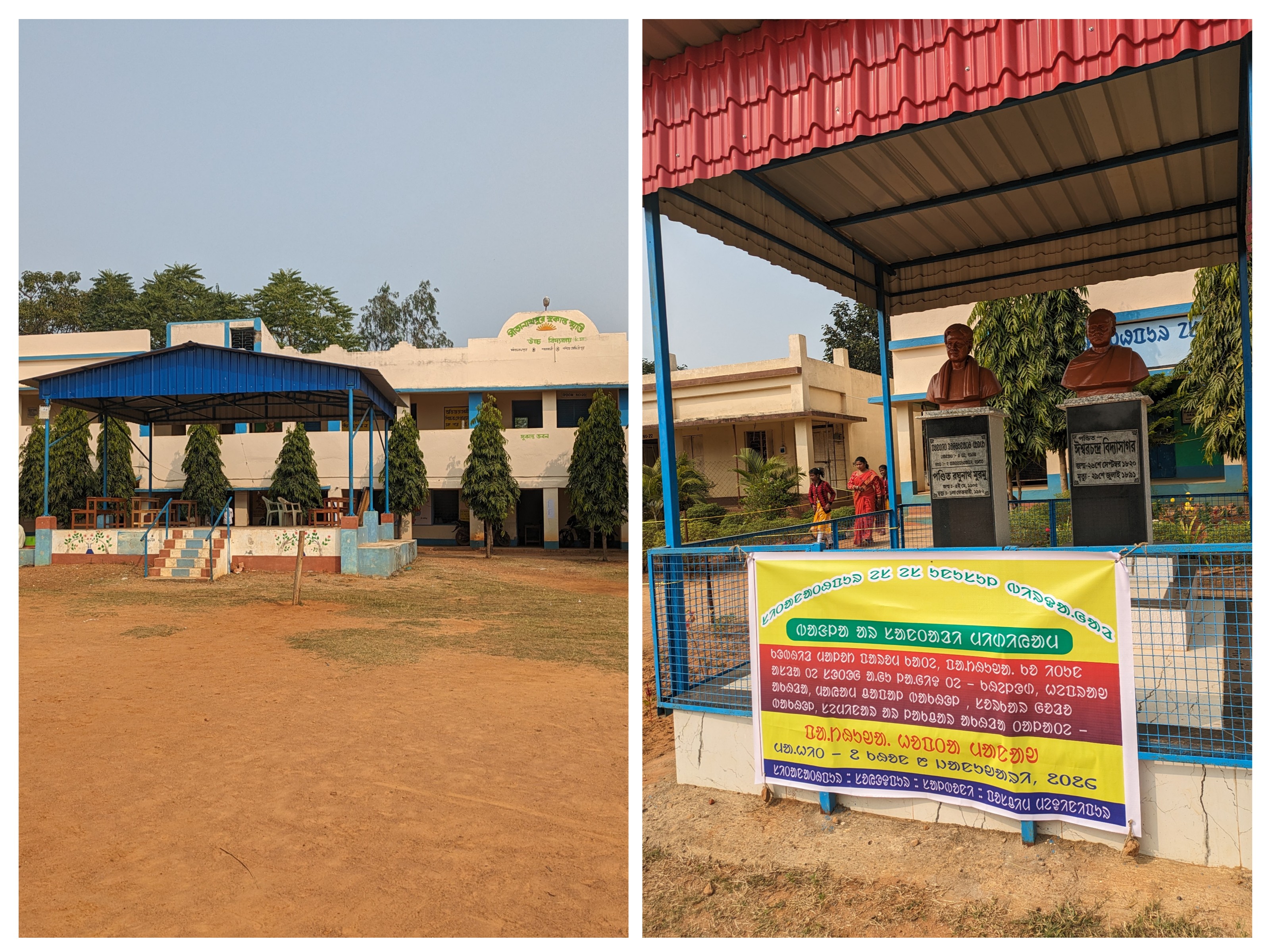
Around the JSW Plant in Salboni are 28 DIZ villages, out of which there are 22 primary schools, 3 (previously 4) Upper Primary schools, and 2 High Schools (one of which has a separate medium for Santhali language, the only other school in the district that offers the language). The majority opinion in the passing area is that education is a secondary option for parents and students. While governments are providing such great incentives for children to enroll in schools, those freebies are the sole purpose of their school enrollment.
At first, I wanted to promote the use of local language. One of the major reasons children don’t want to come to school or don’t seem to understand what they are being taught is because of the language barrier. At home, their parents speak to them in Santhali but in school, they are taught in Bengali. While it might seem that the languages are related and should be easy to pick up, the language is only used in their classrooms and left at the school doors. Even in Sitanathpur High School where they teach Santhali, they face difficulties. While speaking, listening, and understanding are things that come naturally to them, writing and reading in the Ol’Chiki script is unfamiliar and difficult for those fluent in Santhali to grasp.
So ideally, I wanted to focus my project on language and cultural promotion. I had all these wonderful plans and ideas of how I would promote the use of one’s language and the games/activities that I could conduct.
Rookie mistake.
While this might have worked otherwise, think of the long-term outcome for these children. Slowly, many of them wish to continue their education post-secondary education. Now, their entire life, they’ve been taught in Santhali, and suddenly, when they go to college, it’s a completely new world. Students come from all backgrounds in college, and a common language here becomes extremely important to understanding classes and building good relationships.
What are these common languages? English, Bengali, and Hindi. And mostly, 80% of the literature in colleges is written in English. When their basic level of letter identification itself is an issue in Grade 7, how can they read professional/higher educational books?

Now, because they’ve never been exposed to them or been taught formally in these mediums, this unfamiliarity hits them like a tidal wave; overwhelmed, dejected and confused, they drop out.
In today’s interconnected world, English isn’t just another language; it’s the currency of progress. It’s the bridge that connects us to new horizons, new ideas, and new possibilities. The puzzle pieces finally clicked, and the need came from the community themselves. “We want our kids to speak in English so that they too can shine and be able to go to Kolkata and get respectable jobs like you folks”, they said.
I could sense a longing, a yearning for something more from their tone and facial expressions.
And it was at that moment that I knew my journey had just begun.
Press Play.
 iVolunteer Blog - everything about volunteering
2 replies on “Pressing the Restart Button: New friends, new place, new journey”
“Restart. Refresh. Re-begin.” I absolutely adore this phrase.
LikeLike
Hello Vibha! Kudos to your spirit on beginning again. The choice of words in this article are really good. My personal favorite, ‘English isn’t just another language; it’s the currency of progress.’
Keep writing and keep sharing!
LikeLike